

Hair porosity: how to test it and how to dry each type
Recognize hair porosity by its signs instead of a glass of water, and dry and straighten low, medium and high porosity hair so it doesn’t frizz. Backed by research, with a temperature table and an online test.

Hair porosity is one of the most asked-about topics in hair care groups today, and also one of the most confusing. Everyone has heard about the glass of water, about “high” and “low” porosity hair, about oils matched to your type. Hardly anyone has heard that porosity changes depending on how you dry and straighten your hair every morning. And that is crucial.
For twelve years on “Pani Gadżet”, my own show on Polish TV, I tested a great many hair dryers and straighteners, and later I designed ours together with our team. In this guide, I’ve gathered what really works: how to recognize porosity by its signs, why the glass test misleads you, and how to dry and straighten every hair type so it doesn’t frizz. I founded the SkinVibe brand, so wherever I write about equipment, I point directly to our devices.
IN SHORT
- Porosity describes how tightly the cuticle lies against the hair. Low porosity hair is smooth and slippery, medium porosity hair is the easiest to style, and high porosity hair soaks up water and frizzes in humidity.
- A glass of water is not a reliable test. You can tell your porosity by the signs: how your hair dries and how it reacts to humidity, products and heat. These are the questions our hair porosity test asks.
- High porosity is most often the result of bleaching, hot tools and friction. How you dry and straighten your hair is something you control every day.
- Each type needs a different temperature. Keep the hair dryer about 15 cm from your hair and moving, use the straightener only on dry hair, and with high porosity start at 140°C.
What is hair porosity, exactly?
Hair porosity is the degree to which the cuticle, the outer layer of the hair, lies flat against its inner part. The cuticle resembles roof tiles laid one over another. When they lie flat, the hair is smooth and lets little water in. When they are lifted or damaged, the hair soaks up water quickly, dries quickly and easily loses its smoothness.
In hair care, hair is usually divided into three types: low, medium and high porosity. It’s a handy shortcut, but it’s worth knowing where it comes from. Researchers measure porosity as a continuous value rather than three separate boxes, and show that it increases as the hair becomes more damaged. In a paper published in the journal Molecules, bleached hair had markedly higher porosity and absorbed dye much more strongly than natural hair (Müllner et al., Molecules).
I also talked about porosity with trichologist Agnieszka Trepka on our podcast. She described the cuticle exactly like that, as roof tiles made of keratin and pointed out something I hear very often: many people are convinced they have high porosity hair, when in fact it is low porosity. The mistake usually starts with the test everyone knows. More on that in a moment.

The conversation is in Polish. After you click, YouTube (Google) plays the video.
What causes high porosity hair?
Part of your hair’s porosity comes from your genes, but most of the changes come from everyday life. Porosity is raised most by bleaching, color stripping and perms, then by hot tools used too close, too hot or on wet hair, and finally by friction: tugging with a brush, hair ties, towels. That’s why the ends are usually more porous than the hair near the scalp.
Heat affects the cuticle gradually. In a study published in the Annals of Dermatology, a hair dryer held 10 cm from the hair, at a temperature of 61°C, clearly lifted the cuticle, while from 5 cm, at 95°C, it left cracks and holes in it (Lee et al., Ann Dermatol). With a straightener, the threshold is higher: in a classic paper on the effect of heat on hair structure, changes up to 140°C were small and reversible, while above 140°C they were deep and permanent (Bories et al., Int J Cosmet Sci).
In practice, it isn’t one hot styling session that turns hair into “straw”, but hundreds of morning blow-dries and straightening sessions at too high a temperature. The good news is that the same mechanism works the other way, too. Gentler heat and good technique won’t undo the damage, but they will stop it from getting worse.
Hair porosity test: eight questions instead of a glass of water
The most reliable way to recognize porosity is by how your hair behaves day to day. That’s why we created a hair porosity test that asks eight questions about the signs and, after a minute, gives you your type plus tips on how to dry and straighten. You don’t need to enter an email address, and the result appears straight away.
If you’d rather check for yourself, here are the questions that really tell you something about the cuticle:
- Treatments. Have the lengths of your hair been bleached, color-stripped, permed or keratin-straightened? That’s the strongest sign of high porosity.
- Drying time. How long does your hair take to dry without a hair dryer? Low porosity hair can stay damp for more than three hours.
- Water. In the shower, does water run off your hair, or does your hair soak it up in a second?
- Humidity. What happens on a rainy day: nothing, a little frizz or “straw”?
- Touch. Run your fingers along a dry strand from the end to the root. Smooth, slight resistance or rough?
- Products. Is your hair easily weighed down by products, or does it absorb everything, with the ends dry again the day after washing?
- Styling. Does your hairstyle fall apart, hold all day, or does your hair dry out easily?
- Shine. Is your hair glossy and bouncy, or dull and easily stretched?
The more often you pick the last option, the higher your porosity. If your hair behaves differently at the roots than at the ends, you most likely have mixed porosity, which I write about below. The result of a test like this is approximate, but it is based on what you actually see in the mirror.
Why doesn’t the glass of water test work?
The glass test assumes that low porosity hair floats and high porosity hair sinks. In reality, clean hair of every type stays on the surface thanks to the surface tension of the water, and the result is affected by leftover conditioner, oil or dry shampoo. Trichologists agree: observe your hair instead of trusting the glass.
Trichologist Magdalena Szymczak put it plainly in an interview for the Polish TV show Dzień Dobry TVN: “All hair types float on water”, adding that porosity simply has to be observed (Dzień Dobry TVN). Michelle Wong, a chemist and the author of Lab Muffin Beauty Science, explains what the glass really measures: the condition of the hair surface, that is, whether the outer lipid layer is still in place (Lab Muffin Beauty Science).
That’s why I don’t treat the glass as the final word myself. It’s an interesting experiment that may hint at surface damage, but it won’t tell you whether to dry your hair with warm or cool air. The signs will.
Low porosity hair: how to dry and straighten it
Low porosity hair has a cuticle that lies tightly against the hair. It is smooth, shiny and healthy, but it takes a long time to absorb water, takes a long time to dry and is easily weighed down by products. The most common problem isn’t frizz but a hairstyle that falls flat after an hour, because slippery hair doesn’t like to hold its shape.
With this kind of hair, you gain the most from a strong, efficient airflow. Dry it with warm air and a concentrator, section by section, directing the airflow along the hair from the roots to the ends. There’s no need to reach for the hottest setting: it shortens drying by only a moment and overheats the scalp. Once a section is dry, go over it with cool air, which sets the shape.

Straightening is easiest with low porosity, because smooth hair straightens quickly. Start at the lowest temperature at which the section becomes straight, and glide the straightener through once, slowly, instead of several times quickly. For fine hair, 160-165°C is often enough. Thicker hair needs more, but in our podcast Agnieszka Trepka reminded us that above 210°C it gets too hot for the hair, unless we protect it with a heat protectant.

Choose light products and use less than the label suggests, because on low porosity hair the excess just sits on the surface. This matters a lot for styling: too much mousse or oil will make your hairstyle fall flat even faster.
Medium porosity hair: how to keep it in good shape
Medium porosity hair has a slightly raised cuticle. It takes in moisture and products well, has a natural tendency to wave and holds a style without much effort. In our conversation with the trichologist, we heard that most of us have this type. The whole trick is not to push it toward high porosity with heat and treatments.
Dry it with warm, not hot, air. Researchers who compared different drying temperatures found 60°C to be optimal, because hair dried this way later absorbs moisture from the air more slowly, so it frizzes less when the weather changes (Bories et al.). Hold the hair dryer about 15 cm from your head and keep it moving the whole time. In the Annals of Dermatology study, a hair dryer used this way damaged hair less than hours of air-drying (Lee et al.).

For waves, reach for a diffuser, which disperses the airflow and dries your natural wave without brushing it out. I wrote more about how to hold it and what temperature to use in my guide to hair dryers with a diffuser. Straighten only dry hair, usually at 160°C, and at 180°C for curly hair. A steam straightener makes smoothing easier at lower temperatures, so you don’t need to turn up the heat to get sleek, glass-smooth hair.
High porosity hair: how to dry it without frizz
High porosity hair has a cuticle that is lifted or damaged in places. It soaks up water quickly and loses it just as quickly, which is why it frizzes in humidity, looks dull, feels rough and tangles easily. In our conversation with Agnieszka Trepka, one word came up that describes it best: it rustles under your fingers. This is where your drying and straightening technique makes the biggest difference, for better or for worse.
Rule one: don’t leave it wet for long. Many people with high porosity hair give up the hair dryer for fear of heat, yet the Lee study showed that only naturally dried hair had damage to the layer that binds the hair cells together from the inside. The authors state plainly that prolonged moisture can be just as harmful as high temperature. So feel free to use a hair dryer, at the lowest temperature that does the job.
Rule two is about direction. In our conversation with Agnieszka Trepka, one principle kept coming up: direct the air from the scalp downward, the way your hair grows, from a distance of 15 cm, and never move the dryer back against the direction of growth. Moving up and down opens the cuticle you smoothed a moment earlier. Finish with cool air, and use a heat protectant before every hot styling session.

Rule three: never straighten wet or damp hair. Researchers who studied the effect of a hot iron on hair saw bubbles and bulges in the cuticle of wet strands, because water trapped in the hair turns into steam under the hot surface and bursts the cuticle from within (Ruetsch and Kamath, J Cosmet Sci). Start at 140°C, straighten each section in one smooth stroke and save the straightener for the days when you really need it.


The same hair before and after straightening with the Astra steam straightener
One of our customers wrote in a review that her hair was still frizzy “despite heating up to 210 degrees”. With high porosity, a higher temperature is rarely the answer. What helps more often is a lower temperature, a dry section, a slower stroke and steam, which moisturizes the hair while you straighten.
Mixed porosity: different at the roots, different at the ends
Mixed porosity means that near the scalp the hair behaves like low or medium porosity hair, while on the lengths and ends it behaves like high porosity hair. This is very common with bleached and colored hair, because the ends have endured treatments, heat and friction the longest. With long hair, the ends can have as much as several years of drying and straightening behind them.
With mixed porosity, treat each part of your hair separately. Dry the roots efficiently with warm air so they don’t stay wet for long, and the lengths and ends more gently, from farther away, keeping the dryer moving and finishing with cool air. Set the straightener for the ends, not the roots: start at 140-160°C and protect the ends with a heat protectant.
This split also helps with products. A light conditioner at the roots and a richer one on the ends is a simple way to keep the same strand from being weighed down and dried out at the same time.
Hair dryer and straightener temperatures by porosity
I’ve gathered the key numbers in the table. They’re starting points, not rigid rules: thick and dense hair may need one setting higher, and fine hair one setting lower. Three rules apply to every type: the hair dryer about 15 cm from your head and moving, the straightener only on dry hair, and never above 210°C without a heat protectant.
| Porosity | Hair dryer | Straightener (start) |
|---|---|---|
| Low | warm, strong airflow with a concentrator, cool air to finish | 160-185°C, a single pass |
| Medium | warm air around 55-60°C, a diffuser for waves, cool air to finish | 160°C, 180°C for curly hair |
| High | the lowest temperature that does the job, from the roots downward, cool air and a heat protectant | 140°C, ideally with steam |
| Mixed | roots: warm air, quickly; ends: gentler; cool air on the lengths | 140-160°C, set for the ends |

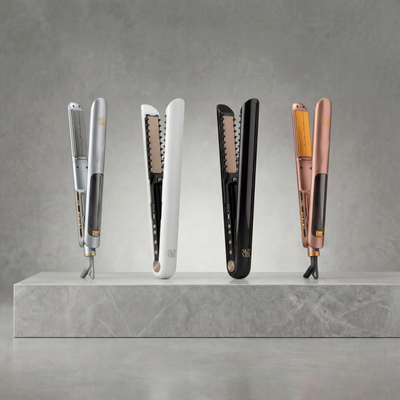
Why do we start at 140°C with high porosity? Because that’s the threshold below which changes in hair structure are reversible in studies. Our Astra steam straightener has this setting, and its manual describes it as the temperature for soft, bleached hair. For a hair dryer, the equivalent is warm air around 55-60°C, not the hottest setting.
Diffuser, cool air, ionization, plasma and steam: which feature helps which hair
Equipment matters for porous hair, but each feature does something different. A diffuser protects your curl pattern, cool air sets the shape, ionization and plasma reduce static and frizz, and steam moisturizes the hair while you straighten. You don’t need all of them at once, only the ones that address your hair’s problem. In practice: for frizz, plasma or ionization is what counts; for curls, a diffuser; and for straightening, steam.
- A diffuser disperses the airflow, so waves and curls dry without being brushed out. It’s useful with medium and high porosity when the hair has a natural curl.
- Cool air at the end of drying sets your style and smooths the strands. It’s worth using with every type, and with low porosity it’s the simplest way to keep your style from falling flat.
- Ionization means emitting negative ions, which neutralize charges on the surface of the hair, so the strands stop going static. I wrote about the differences between models in my guide to hair dryers with ionization.
- Plasma technology emits positive and negative ions at the same time. In our Aurea, that’s a billion positive and negative ions per cubic centimeter, which close the hair cuticle. More in the article on plasma technology in hair dryers.
- Steam in a straightener moisturizes the hair while you straighten and makes smoothing easier at lower temperatures. With high porosity, it’s one of the most noticeable differences, as I described in my guide to steam straighteners.

If your hair frizzes and goes static even after ordinary drying, also take a look at the guide to static hair. And if your ends break and smell burnt after using a straightener, read how to rescue hair burned by a straightener.
Can hair porosity be changed?
Porosity that has already developed can’t be reversed: a damaged cuticle doesn’t rebuild itself. What you can do is stop it from increasing and improve how your hair looks and behaves. Products smooth the surface until the next wash, and gentler drying and straightening mean that new hair growing from the roots doesn’t go through the same journey.
In practice, it looks like this: new growth has a porosity close to natural, and the ends get trimmed off over time. If at the same time you stop straightening wet hair, lower the temperature and start drying from the roots downward, after a few months the difference between the roots and the ends will start to shrink. It’s not a quick effect, but it is a lasting one.
I’ll add one honest note: dividing hair into three types is a cosmetic convention. Your hair doesn’t have to fit perfectly into any box, and that’s fine. What matters is how it reacts to heat and humidity, because that tells you what to change in your morning routine.
Which hair dryer and straightener should you choose for porous hair?
For porous hair, look for a hair dryer with temperature control and warm air around 55-60°C, with a sensor that makes sure the strands don’t overheat, and a straightener that starts at 140°C. For frizz, it’s worth adding ionization or plasma technology, and for straightening, steam. In practice, you’ll find these three specs on the product page within a minute, before you buy anything.
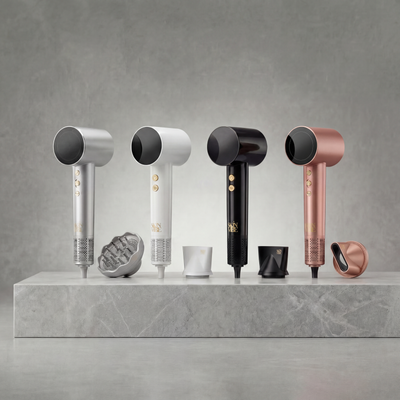
For high and mixed porosity, our Aurea Family x Plasma hair dryer works best: it has warm air at 55°C, a sensor that measures the temperature 100 times per second, an alternating warm-cool mode, plasma technology and a wavy diffuser that I customized for waves and curls. For straightening, the Astra I wrote about above: steam and five settings starting at 140°C.
For low porosity, when hair takes a long time to dry and frizz isn’t a problem, a good choice is the Libra AirLoom hair dryer, with a 110,000 rpm motor and ionization of 200 million negative ions per cubic centimeter. For smooth strands and touch-ups during the day, the Luna cordless straightener with three temperatures starting at 165°C is all you need. If you travel a lot, Nova PlasmaGo weighs 310 g and has the same plasma technology as Aurea.
If you dry your hair and go straight on to styling waves, take a look at our hot air styler, Nuvia AirPlasma. It styles with air of up to 90°C, not with a barrel or plate that has its own heating element. It gives you cool air at the press of a button, and its plasma delivers 400 million positive and negative ions per cubic centimeter. With high porosity, choose the hot-cold cycle (about 55°C), in which warm air alternates with cool air, and finish each section with cool air. I’ve also described how to use a hot air styler step by step.

Not sure which model suits your hair? Our hair dryer and straightener quiz will point you to one device in 90 seconds and explain why. You’ll also find a full comparison in the hair dryers and hair straighteners categories, and the step-by-step technique in the guide on how to dry hair properly.
Frequently asked questions about hair porosity
How do I know my hair porosity?
The most reliable way is by the signs, not the glass of water test. Pay attention to whether your hair has been bleached, how long it takes to dry without a hair dryer, how quickly it soaks up water, what happens to it on a humid day, how it feels to the touch and whether it shines. Our hair porosity test asks eight questions like these and, after a minute, gives you your type and tips.
What does it mean when hair is porous?
It means that the cuticle, the outer layer of the hair, doesn’t lie tightly against it. Hair like this absorbs water and products quickly but loses them just as quickly, so it can be dry, dull and frizzy in humidity. In everyday speech, “porous” usually means “high porosity”, although all hair has some porosity.
How can I tell if my hair is low porosity?
It’s smooth, slippery and shiny, water runs off it for a long time, it can take more than three hours to dry, and products easily weigh it down and make it greasy. Hairstyles often fall flat quickly, because slippery hair doesn’t like to hold its shape. This kind of hair tolerates heat well, but it doesn’t need the highest temperatures.
How long does high porosity hair take to dry?
Usually less time than low porosity hair of the same length, because the cuticle releases water faster. But drying time also depends on thickness, density and length, so on its own it doesn’t determine the type. That’s why our test combines it with other signs, such as how the hair reacts to humidity and treatments.
What is the difference between high and low porosity hair?
Low porosity hair has a tightly closed cuticle: it’s smooth, shiny, slow to dry and easily weighed down. High porosity hair has a lifted cuticle: it soaks up water quickly, frizzes in humidity, and is rough and dull. The first needs efficient airflow and light products; the second needs a lower temperature, drying from the roots downward and protection for the ends.
Can low porosity hair be curly?
Yes. Porosity and curl are two different traits, so curly hair can have any porosity. You’ll recognize it by the same signs as with straight hair: how your hair soaks up water, how long it takes to dry and how it reacts to products. For curly low porosity hair, a diffuser and warm rather than hot air work well.
What is the best hair porosity?
There’s no better or worse, but medium porosity hair is the easiest to style day to day: it takes in moisture well, holds a style and doesn’t frizz at the first change in the weather. Low porosity hair is the healthiest, though harder to style, and high porosity hair needs gentle drying and straightening the most.
Does a hair dryer damage high porosity hair?
Not if you use it sensibly. In the Annals of Dermatology study, a hair dryer held 15 cm from the hair and kept moving damaged it less than hours of air-drying. What matters is a warm rather than hot temperature, drying from the roots downward and cool air at the end.
To finish, the question I ask myself before every morning blow-dry: do I really need the hottest setting today? Most of the time, the answer is “no”, and a few weeks later my hair thanks me for it.
Anna Nowak-Ibisz, co-founder of SkinVibe