

Ionic hair dryer: how to choose one and is it worth it?
An ionic hair dryer is worth it if your hair frizzes or gets static. Choose one that states its number of ions and has a BLDC motor, temperature control with cold air, a weight of 400-650 g and the right nozzles. No ion count is a warning sign.

Hi. This is Anna Nowak-Ibisz, co-founder of SkinVibe.
“The most important thing is that the hair dryer has ionization.” I’ve been hearing this sentence from women for more than ten years: on photo shoots, in your messages, in conversations over tea. And you know what? There’s a lot of truth in it. But between “has ionization” and “has ionization you can really feel” there’s a gap that hardly anyone talks about. I tested a great many hair dryers before I founded the SkinVibe brand, and today I’ll show you exactly how to choose one that delivers the effect, not just a label on the box.
IN SHORT. An ionic hair dryer, before you buy
- Ionization neutralizes the electrical charges on your hair. In practice: less frizz, less static, easier styling.
- It’s worth it if your hair frizzes or gets static, especially in fall and winter, after wearing a hat and in dry air.
- When choosing, look at the specifics: a stated number of ions, the motor, temperature control with cold air, weight, a full set of nozzles.
- Warning sign: the word “ionization” with no number and no details. A feature like that may be impossible to feel.
- Plasma is ionization taken a step further, because it emits negative and positive ions at the same time. I explain this in a separate article.
Is an ionic hair dryer worth buying?
It is if your hair frizzes, gets static or is hard to style. Ionization neutralizes the electrical charges that build up on hair while drying: the cuticle closes, strands become smoother and stop “flying” and sticking out. It’s a real, physical difference, not a marketing extra. If your number one problem is static in winter, also read why hair gets static and how to dry it so it stops.
There is one “but” you write to us about regularly: “my previous hair dryer had ionization too, but I couldn’t feel it at all”. And that is the heart of the whole topic. The mere presence of a feature says nothing about its strength. A weak ion generator in a cheap device can be a pure formality: the light is on, the label is there, and your hair still does its own thing. That’s why this guide doesn’t answer the question “does ionization work” (it does, and I break down what ionization does in a hair dryer in detail separately, together with the question of safety), but a harder one: how to tell real ionization from box-label ionization.

Who benefits most from ionization? Fine, frizz-prone hair, long hair that gets static from brushing, and every one of you who takes off a hat in winter thinking “well, there goes my hair”. If your hair is thick, heavy and perfectly calm, the difference will be subtler. In practice: the more your hair “has a life of its own”, the more ionization is for you.
How to choose an ionic hair dryer: 6 criteria
Over the years on “Pani Gadżet”, my own show on Polish TV, I learned one thing: you recognize a good device by its specifics, not its adjectives. Here are the specifics I check in an ionic hair dryer.
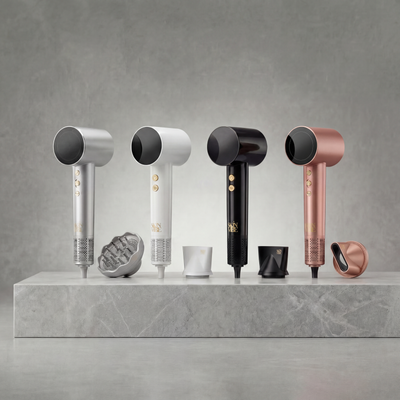
1. The number of ions stated outright. This is my first filter. If a brand knows how many ions its hair dryer emits, it says so proudly. Our ionic hair dryer Libra AirLoom generates 200 million negative ions per cm³, and the flagship Aurea Family x Plasma generates 1 billion positive and negative ions per cubic centimeter of air. The point isn’t for you to remember these numbers. The point is transparency: “ionization” without any number is like a “powerful motor” without the power rating.
2. Type of emission: ionization or plasma. Classic ionization emits negative ions, and that’s enough for most hair. Plasma goes a step further: it emits negative and positive ions at the same time, so besides reducing static it also supports moisture and shine. It’s an optional higher-end technology, not a must.
3. The motor. Higher-end hair dryers have a BLDC (brushless) motor. It spins much faster than a classic AC motor (brushed, older generation), top models reach as much as 110,000 revolutions per minute, and its lifespan is measured in years, not seasons: up to 10,000 hours of operation versus 500-1,500 hours in the older design. In practice: a strong, focused airflow cuts the time it takes to dry long hair from over ten minutes to a few, and ionization has a chance to work along the whole length of the strand, not just at the roots.
4. Temperature control and cold air. Trichologist Agnieszka Trepka said it plainly in our podcast (in Polish): the maximum sensible drying temperature is 90°C, and the ideal is around 70°C. So look for a hair dryer that shows how many degrees it’s delivering and lets you actually choose that temperature. Cold air isn’t a gimmick: cool air at the end closes the cuticle and sets the effect of ionization.
5. Weight and cable. The comfortable range for hair dryers with a BLDC motor is 400-650 g, and the lighter the better. In practice: with long, thick hair, the difference between 400 and 600 grams is the difference between calm drying and an aching forearm. Check the cable too: 2.7 m lets you dry in front of the mirror even when the outlet is far away, while a shorter one can force you into an awkward position every morning.
6. Nozzles. The minimum is a concentrator, and for curls and waves a diffuser. Three nozzles, meaning a primary concentrator, a professional concentrator and a diffuser, are the most convenient setup I know: one for everyday drying, the second for precise styling and lifting hair at the roots, the third for curls. It’s good if the attachment is magnetic, because changing the nozzle in one move really changes your daily routine. If you have curls or waves, the shape of the diffuser makes a difference; I describe the types of diffusers and the drying technique in my guide to the hair dryer with a diffuser.

| Criterion | What to look for | Warning sign |
|---|---|---|
| Ionization | A stated number of ions | Just the word “ION”, zero details |
| Motor | BLDC (brushless) | No information on the motor type |
| Temperature | Choice of settings + cold air | One setting: always hot |
| Weight | 400-650 g, the lighter the better | No weight in the specifications |
| Noise level | Below 70 dB | Noise “like a vacuum cleaner” in reviews |
| Nozzles | Concentrator + diffuser for curls | Just the dryer, no accessories |
A word about noise, because almost everyone skips it: the US institute NIDCD states that long or repeated exposure to sounds of 85 dB and above can damage hearing. A hair dryer runs right next to your head every day, so the quieter the better: below 70 dB is comfortable, and the quietest models go below 60 dB.
How can you tell that a hair dryer really has ionization?
On the product page, look for three things: the name of the technology (ionization, “ionic”, plasma), the number of ions, and whether ionization works all the time or is switched on with a button. In many hair dryers, including ours, the ion generator works throughout drying and doesn’t need any button, which is why its “invisibility” is sometimes mistaken for a missing feature.
And after you buy? The test is simple and can be done at home. Dry your hair as usual, then brush through it and watch: if the strands don’t lift after the brush, don’t crackle when you take off a sweater and fall into place without sprays, ionization is doing its job. In practice: you can see the difference best in winter, in heated, dry rooms, because that’s when static is strongest.
How do you use the ionization feature day to day?
Good news: there’s nothing to learn. Dry your hair from roots to ends, directing the airflow along the strand, from top to bottom, because that also smooths the cuticle. For the last few dozen seconds, switch to cold air: the cool air seals what ionization has smoothed, and your style lasts longer. For curls, put on the diffuser; ionization and curls are a great pair, because less frizz means better-defined waves. I describe the whole drying technique, step by step, in my guide on how to dry your hair properly.
Lightweight, professional, travel: which ionic hair dryer is right for you?
Needs vary, so instead of naming one “best” hair dryer I’d rather lay out honestly what suits whom. If you’re torn between our models, I’ve covered that separately: Aurea, Libra or Nova.
A lightweight ionic hair dryer. If drying long hair takes you 10-15 minutes a day, weight makes a huge difference. Aurea weighs 410 g and Libra 420 g, precisely because we designed them with everyday, longer drying without wrist pain in mind.
A professional ionic hair dryer. Look for parameters, not just the word: a high-speed BLDC motor, stable temperature control and a professional concentrator for precise styling. That’s the set of features that makes your hair look like it was done by a hairdresser, not “just dried”. Salon equipment is a separate topic, which is why I’ve explained in a guide how to choose a salon hair dryer.
A small ionic hair dryer for travel. Here, honesty calls for a sentence you need to hear: a typical travel hair dryer is a compromise, often a big one. Before you buy a separate device for your suitcase, read my article on whether you need a travel hair dryer at all.
And our hair dryers? Libra AirLoom stands for classic, powerful ionization: 200 million negative ions per cm³, a 110,000 rpm BLDC motor, 4 temperature settings with cold air and 3 magnetic nozzles. According to our measurements, Libra gives 45% less static, 25% more shine and a 15% shorter drying time. Libra is for those of you who want ionization you can feel and SkinVibe quality in a more affordable version.

The video is in Polish. After you click, YouTube (Google) plays the video.
Aurea Family x Plasma is a level up: plasma technology, meaning 1 billion positive and negative ions per cubic centimeter, 7 operating modes including child and pet modes, a touch sensor and operation at a maximum of 59 dB. Aurea is for those of you who dry your hair every day, take frizz seriously or are buying one hair dryer for the whole household. It’s one of the reasons we received the Polish award Kobieca Marka Roku 2025 (Women’s Brand of the Year).

If you’re torn between them, we’ve prepared a comparison of our hair dryers feature by feature, and you’ll find all our ionic hair dryers and plasma models in one collection. Prefer a ready answer to a table? Take the hair quiz - in 90 seconds it will point you to a model that suits your needs. And if you don’t know where to start with choosing a device at all, my big guide on how to choose a hair dryer walks you through everything step by step.
There’s also a fourth option: a hot air styler, which dries and styles at the same time. Our Nuvia AirPlasma hot air styler has plasma instead of plain ionization, meaning positive and negative ions at the same time, and seven attachments, including curling barrels and brushes.
Choose specifics, not labels. Your hair can tell. 🤍
Anna Nowak-Ibisz, co-founder of SkinVibe
Do you have a question about choosing a hair dryer that isn’t covered here? Write to us, we reply to every one of you.
Frequently asked questions about choosing an ionic hair dryer
Is an ionic hair dryer worth buying?
Yes, if your hair frizzes, gets static or is hard to style: ionization neutralizes the electrical charges on your hair, closes the cuticle and really smooths the strands. Thick, heavy, calm hair will notice it least. The key is the quality of the ion generator, so choose models that state the number of ions emitted.
How can you tell that a hair dryer has ionization?
On the product page, look for the name of the technology (ionization, “ionic”, plasma) and the number of ions, for example 200 million negative ions per cm³. In many models, ionization works constantly during drying and has no separate button. After you buy, check the effect: after drying, your hair shouldn’t lift after the brush or crackle when you take off clothes.
Does ionization in a hair dryer wear out?
The ion generator is part of the hair dryer’s electronics, not a cartridge that runs out: it works as long as the device works. If the effect weakens over time, the most common culprit is a dirty air filter, which makes the hair dryer work less efficiently. In our models, the filter is magnetic and takes a few seconds to clean.
Which hair dryer damages hair the least?
The one that lets you control the temperature and that you use sensibly. Drying at around 70°C is safer for hair than drying at maximum heat, as long as you keep your distance and keep the dryer moving. Ionization helps too, because it smooths hair without extra heat. I write more about the technique itself in my guide to drying hair properly.
Which ionic hair dryer is the best?
The best one is the one that suits your hair and routine, not a ranking. Check three things: a stated number of ions, a BLDC motor with real temperature control, and a weight of up to 650 g with a full set of nozzles for your hair type. A hair dryer that meets all three conditions will be a good choice for years.
What does ionization do in a straightener, and is it worth it?
Ionization in a straightener works on the same principle as in a hair dryer: negative ions neutralize the charge that makes hair frizz and get static, so strands are smoother and lift less after straightening. The difference is in scale: a straightener is in contact with a narrow strand for a few seconds, so here ionization mainly helps with frizz and shine and doesn’t shorten styling. I describe when it’s worth paying extra for it in my guide to choosing a hair straightener, and I explain how ionization differs from plasma there in my article on what an ionic straightener does.