

Hot air styler: how it works, how to choose and how to use it
A hot air styler dries and styles with heated air, not with a barrel or plate that has its own heating element. A rotating one adds volume, one with attachments also curls. Curls hold when you curl slightly damp strands and set each one with cold air.

A hot air styler is a device you’ve been asking us about for a long time: one instead of a hair dryer, a curling iron and a brush. Your questions and reviews of these devices point to one thing: disappointment rarely comes from the device itself, but most often from strands that are too wet, skipping the cold-air finish and an attachment that doesn’t suit the length of your hair.
For twelve years on “Pani Gadżet”, my own show on Polish TV, I tested a great many hair dryers, so I know what to look for in a spec sheet. I founded the SkinVibe brand, which is why I write about our Nuvia separately, at the end, together with who it won’t suit.
IN SHORT
- A hot air styler dries and styles with a stream of heated air, not with a barrel or plate that has its own heating element. You’ll find the maximum air temperature in the model’s specifications (in our Nuvia, it’s 90°C). A classic curling iron and a straightener work with hot metal; our straighteners run at 140 to 220°C.
- There are two types: rotating, meaning a hair dryer with a spinning brush, and multifunctional, with interchangeable attachments. The first is good for volume, the second also gives you curls and waves.
- Curls hold when you curl slightly damp strands and set each one with cold air. On wet or completely dry hair, the curl won’t take.
- When choosing, look at the temperature modes, cold air, barrel diameters and whether one attachment curls in both directions.
What is a hot air styler?
A hot air styler is a device that combines a hair dryer with styling tools: a curling barrel, a styling brush and sometimes a diffuser. Instead of a plate with its own heating element, it works with a stream of heated air, so you dry wet hair and shape it straight away with the same device. In stores, you’ll also find it called an air styler, a hot air brush or a multistyler.
The easiest way to think of it is as a hair dryer onto which you fit a brush or a barrel instead of a nozzle. The air comes out through the attachment and works on the strand straight away: it smooths it, lifts it at the roots or wraps it into a curl. In practice, it replaces four devices: a hair dryer, a curling iron, a styling brush and a diffuser.

How does a hot air styler work?
A hot air styler works with a stream of heated air that comes out through the attachment and dries the strand in the shape you give it: a brush smooths it or turns it under, and a barrel wraps it into a curl. In models with air curling barrels, the barrel has slots through which air flows along its surface, so a strand held next to it wraps around it on its own. Cold air at the end sets the shape.
Physicists call this the Coandă effect: a stream of gas tends to cling to the nearest surface. In practice, this means you hold the end of the strand against the barrel and the air does the rest. The first attempts take a bit of practice, because you have to learn at what angle to hold the attachment and for how long. Rotating brushes work differently: the strand winds around the bristles of the spinning brush, and the air dries it.
The second important thing is temperature. Trichologist Agnieszka Trepka says in our podcast (in Polish) that with straighteners and curling irons, anything above 210°C is too much for hair, unless you protect it with a heat protectant. For hair dryers, she says in the same conversation that the upper limit is around 90°C and the ideal is around 70°C. The temperature of hot air stylers depends on the model, so check it in the specifications. Our Nuvia reaches a maximum of 90°C.

Hot air styler: rotating or with attachments?
A rotating hot air styler is a hair dryer with a round brush that spins by itself. It dries and adds volume, turns the ends under and smooths, and with the smallest brush you can create a loose wave, but not a defined curl like one from a curling iron. The version with interchangeable attachments has separate curling barrels, brushes and nozzles, so besides styling, it also creates curls and waves. The choice depends on what hairstyle you want day to day.
With a rotating brush, be careful with long, fine hair, because at the wrong angle the strand can get tangled in it. An air curling barrel wraps the strand loosely, so the risk is lower, but there is a learning curve: which attachment to choose and which way to curl. For short hair, check whether the set includes a small rotating brush, about 30 mm. In many models, only the large one rotates, and you won’t turn short strands under with it.
| Type | What it does best | Best for |
|---|---|---|
| Rotating (spinning brush) | Dries with volume, turns ends under, smooths | Shoulder-length hair you want to style quickly, without curls |
| With heated-air attachments | Dries, creates curls and waves, smooths, dries curls with a diffuser | Medium and long hair, when you want both waves and a sleek finish |
| Blow dryer brush (non-rotating) | A simple blow-dry and volume at the roots | Short hair and people who rarely style |
Does a hot air styler damage hair?
A hot air styler usually puts less strain on hair than a curling iron or a straightener, because it curls with heated air, not with a barrel or plate that has its own heating element. That doesn’t mean it’s harmless. The same mistakes hurt as with a hair dryer: the highest temperature on fine hair, a stream held in one spot and touching up the same strands every day. So before you buy, check how many degrees the hottest mode reaches.
In a 2011 study by Lee and colleagues, the hair surface was damaged more, the higher the drying temperature. A hair dryer kept moving at a distance of 15 cm did less damage than letting hair dry on its own for a long time. The study was about a regular hair dryer, but the conclusion fits here too: match the temperature to your hair and keep the stream moving.
One thing calls for caution: styling dripping-wet hair. In a study on how water affects heat damage, heat acting on wet hair damaged its structure more than on dry hair, because the water evaporated violently. That study looked at high temperatures, but the rule is simple: pre-dry first, then curl. I write more about how to recognize overheated strands in my article on heat-damaged hair.
How do you choose a hot air styler?
You can tell a good hot air styler by whether it gives you control: several temperature modes, a separate cold air setting, curling barrels in two diameters and the ability to curl in both directions with the same attachment. Only then look at power, ion technology and comfort, meaning weight, cable length and how the attachments go on. The number of attachments on its own says little.
- Temperature modes. At least three, including a cool one. Fine and color-treated hair likes a lower setting, thick and coarse hair a higher one.
- Cold air at the push of a button. That’s what sets the curl. It’s most convenient when you switch it on by holding a button, without changing the mode.
- Two barrel diameters. The smaller one, about 30 mm, gives bouncy curls. The larger one, about 40 mm, gives loose waves on long hair.
- Two curl directions. Curls styled away from the face on both sides of the head look more natural. With a single barrel that curls in only one direction, you do the other half of your head at an awkward angle.
- Motor and airflow. A brushless motor gives a strong stream with less weight. The airflow determines how long drying takes and whether the strand wraps around the barrel at all. I explain how to read these numbers in my guide how to choose a hair dryer.
- Maximum temperature in degrees. Look for it in the specifications, not in the advertising slogan. For fine and bleached hair, a mode around 70°C is useful.
- Ions or plasma. They reduce static and frizz. I explain the difference between them in my article on plasma technology in hair dryers.
- Comfort. Weight in your hand, a cable that reaches from the outlet to the mirror, click-on attachments and a filter that’s easy to clean.
- Warranty and service. Rotating tips and attachment catches work every time you use the device, so check how long the warranty lasts and where the service center is.

How do you use a hot air styler step by step?
You use a hot air styler in three stages: first you pre-dry your hair with the nozzle until it’s slightly damp, then you wrap strands around the curling barrel or brush, and finally you set each one with cold air. The most common mistake is curling hair that’s too wet or completely dry. In the first case, the strand doesn’t have time to dry in shape; in the second, the curl won’t take.

- Pre-dry. Dry your hair with the nozzle (I explain how to do it without overheating in my guide how to dry your hair properly) until it’s noticeably damp but no longer wet, roughly halfway. At this stage, apply mousse if you want your curls to last until evening.
- Section your hair. Clip up the top and work from the bottom, in strands as wide as the barrel. A strand that’s too thick won’t wrap evenly.
- Wrap. Hold the end of the strand against the barrel and let the air wrap it around at least twice. Hold for 8-12 seconds.
- Set. Switch on cold air for a few seconds until the barrel cools down. Only then slide the barrel down and out.
- Leave it alone. Don’t brush out the curls straight away. With fine hair, pin them up with clips for 10-20 minutes, then loosen them with your fingers.
The first two or three times, the whole thing will take longer, even 30-45 minutes, because you’re learning the order of the attachments and the angle. After a few washes, you usually get down to 15-25 minutes from wet hair to a finished style. If you want to turn these curls into one soft wave for the evening, see how to create Hollywood waves with a hot air styler.
Why do curls from a hot air styler drop?
Curls from a hot air styler most often drop for three reasons: the strand was too wet or too dry, the cold-air finish was skipped, or the hair picked up moisture from the air. The shape of a curl is held by temporary bonds in the keratin, which form when the hair cools and dries in its new position. Water loosens them again, which is why the curl disappears faster on a rainy day.
On straight, fine hair, heated air will give you soft waves and volume rather than bouncy curls that last three days. You can improve the hold: mousse on damp strands, a smaller barrel, cold air on every strand and a moment in a clip. If you need a curl that survives everything, a straightener or a classic curling iron will give a stronger curl, and I write separately about how to create curls with a straightener.
Which hot air styler for short, curly and fine hair?
A hot air styler works for most hair, but each type needs a different attachment. You style short hair with a round brush and long, thick hair with the larger barrel and an oval brush; you dry curly hair with a diffuser and curl fine hair with the smaller barrel at a lower temperature. There’s one limitation: a curling barrel needs a strand that wraps around it at least twice.
Short hair and bobs. Curling barrels usually won’t help here, because the strand is too short. A round brush, on the other hand, will turn the ends under and lift the hair at the roots from chin length.

Curly and wavy hair. For drying natural curls, there’s the diffuser, which disperses the stream and doesn’t break up the curl. A hot air styler won’t straighten very tightly curled hair the way a straightener does, so smoothing with a brush will take longer. I describe how to dry curls in my article on the hair dryer with a diffuser.

Fine and color-treated hair. Work at a medium temperature, with the smaller barrel, and finish each strand with cold air. If you don’t know how your hair absorbs water and heat, take the hair porosity test first. High porosity strands dry out faster.
Nuvia: our hot air styler
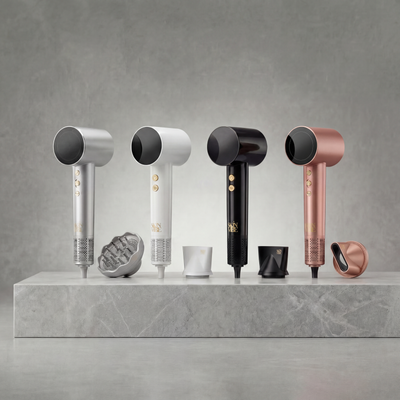
Nuvia AirPlasma is a hot air styler with seven attachments on one body: Drying Nozzle, Concentrator, Diffuser, 32 mm and 40 mm Curling Barrels, Oval Brush and Round Brush. We worked on it for many months so that one device could replace a hair dryer, a curling iron, a brush and a diffuser. It curls with air of up to 90°C, and with each curling barrel you can curl a strand in both directions.
The curling barrels have a rotating tip: you turn it and the airflow changes direction, so with the same barrel you create curls away from the face on the left and right side of your head. You switch on the cold shot by holding the temperature button for about 1.5 seconds. There are four modes to choose from: 30°C, 70°C, 90°C and a hot-cold cycle, plus three airflow speeds.
Inside, there’s a 110,000 rpm brushless motor with airflow of up to 24 m/s, an NTC sensor measures the air temperature 100 times per second, and plasma delivers 400 million positive and negative ions per cubic centimeter, so hair frizzes less. It weighs 477 g with the cable and without attachments, the cable is 2.7 m long, and the attachments click into place.

What Nuvia won’t do: it won’t straighten very curly hair the way a straightener does, on straight and fine hair it gives soft waves rather than bouncy curls that last several days, and the curling barrels need hair past your shoulders. Your first styling sessions will take longer until you learn the attachments. If you’re torn between it and a hair dryer, our hair tool quiz will suggest what suits your hair.
You’ll also find Nuvia in the hot air stylers category in our store.
In a 90-second video, I show what’s in the box and how the curling barrel changes the direction of the curl.

The video is in Polish. After you click, YouTube (Google) plays the video.
Frequently asked questions about hot air stylers
Do you use a hot air styler on wet or dry hair?
On wet hair, you fit only the drying nozzle and pre-dry it until it’s slightly damp, roughly halfway. Curling barrels and brushes work best on exactly these damp strands. On dripping-wet hair, the curl doesn’t have time to dry in shape, and on completely dry hair, the air has nothing to set, so the curls drop quickly.
Can a hot air styler replace a hair dryer?
Yes, if it has a separate drying nozzle. Then you dry wet hair with it as with a regular hair dryer, and afterwards switch the attachment to a curling barrel or brush. Rotating versions without a nozzle also dry, but always with the brush in your hair, which can be tiring with long, thick hair.
Can a hot air styler replace a straightener?
Partly. An oval brush will smooth straight and slightly wavy hair and give it shine, but it won’t give you the glass-smooth finish of a straightener, especially on very curly hair. If you straighten very curly hair every day, the straightener stays in your kit. If what you want is a sleek blow-dry, a hot air styler is usually enough.
How is a hot air styler different from a regular curling iron?
A regular curling iron has a barrel with a heating element and curls dry hair through contact with a hot surface, so it gives a strong, long-lasting curl. A hot air styler wraps a damp strand with a stream of heated air whose temperature depends on the model (in our Nuvia, a maximum of 90°C). The curl is softer, but you dry and curl with one device.
Can you use a hot air styler every day?
Yes, as long as you match the temperature to your hair and don’t touch up the same strands several times a day. With fine or damaged hair, work in the medium mode and finish with cold air. On days without curls, the drying nozzle on its own at a lower temperature is enough, and clean the device’s filter regularly so the air flows freely.
How long does styling with a hot air styler take?
At first, even 30-45 minutes, because you’re learning the angle and the order of the attachments. After a few uses, the whole process, from wet hair to curls, usually takes 15-25 minutes. You’ll save the most time on pre-drying: the stronger the airflow, the sooner you get to the point where you can start curling.
Which hot air styler is the best?
The best one is the one that suits the length and type of your hair. For short and shoulder-length hair, a rotating model or a set with a small round brush is enough. For curls on long hair, you need air curling barrels in two diameters, cold air at the push of a button and a temperature stated in degrees. The number of attachments matters less than whether you’ll use each one.
Your first week with a hot air styler is about learning the angle and the order of the attachments, so don’t judge it by the first try. After that, you dry and curl with one device, on damp hair and with heated air instead of a barrel with its own heating element.
Anna Nowak-Ibisz, co-founder of SkinVibe