

Diffuser hair dryer for curly hair: how to choose and use one
A diffuser spreads the airflow, so curls dry in their own shape without frizz. For curly hair, choose a hair dryer with a diffuser in the box, a low temperature (50-60°C), cold air and adjustable airflow; hold the diffuser still at the roots and finish with cold air.

The diffuser is the nozzle you ask me about most often and the one most often missing from the box. Over twelve years on “Pani Gadżet”, my own show on Polish TV, dozens of hair dryers passed through my hands, and in most of them the diffuser was an extra of the “it’s there because it has to be” kind: a shallow bowl, too little air, strands sliding off to the sides. Yet for curly and wavy hair, it isn’t an extra, it’s half the device.
That’s why, when I founded the SkinVibe brand, I worked on Aurea’s diffuser personally. Below, I explain what a diffuser actually does with the air, which shape makes sense for which curl, how to choose a hair dryer for curly hair and how to diffuse step by step so your curls come out bouncy, not frizzy. The examples come from our hair dryers, but the technique is universal.
IN SHORT
- A diffuser spreads the airflow over a large area: less pressure on each strand, more even heat. That’s why it dries curls without breaking up the curl pattern and without frizz.
- It won’t create curls from straight hair. It sets and enhances the curl you already have; on straight hair, it gives you volume at the roots at most.
- Shape matters: a classic round bowl dries gently, a diffuser with distinct prongs separates strands better, and a deep bowl with long fingers handles long, tightly curled hair best.
- For curly hair, what counts is: a diffuser in the box, a low temperature (50-60°C) with cold air, adjustable airflow, ionization or plasma against frizz, and low weight, because you hold the diffuser still against your head.
- The technique in one sentence: place the strand in the diffuser as if in a bowl, lift it to the roots, hold still for a minute or two, dry to 80-90%, finish with cold air and don’t touch your hair until it cools down.
What is a hair dryer diffuser and what does it do?
A diffuser is a wide attachment with holes and prongs that spreads the airflow from the hair dryer over a large area. Instead of one strong blast that blows the curl apart, you get many weak streams and even heat. As a result, curls and waves dry in the shape they’ve settled into, and hair frizzes less.
The physics is simple: the same amount of air passes through dozens of small holes instead of one outlet, so each strand gets less pressure. The prongs, or “fingers” of the diffuser, do a second thing: they support the strands from below and let you lift them to the roots, so the curl dries curled rather than stretched under its own weight. A concentrator works the other way around: it narrows the stream, directs the air down the hair and smooths the cuticle. That’s why you put on the concentrator for straight hair and for styling with a brush, and the diffuser for curls. In our hair dryers, all nozzles attach magnetically and rotate 360°, so changing them takes one move, not a wrestle with a clip.
A diffuser also helps fine, straight hair that lies flat at the roots: a few minutes with your head tilted gives natural volume without backcombing. More on that below, in a separate section.

Does a hair dryer with a diffuser create curls?
No, a diffuser won’t create curls from straight hair. It sets and enhances the curl your hair already has: it turns waves into more defined waves and loose curls into bouncy curls. On straight hair, it gives you volume at the roots and slightly tousled ends at most. If you want curls from straight hair, you need a straightener or a curling iron, not a hair dryer.
It’s the most common disappointment I hear about after people buy a “hair dryer for curls”. The curl is written into the structure of the hair; the diffuser only makes sure it survives drying. The less you move your hair while it dries, the more curl remains, and that’s the whole secret. One of our customers wrote after a month with Aurea that her hair “started curling more” and that her old hair dryer had simply been drying it out; another put it briefly: “finally I have curly hair instead of straw”. Both described the same thing: the curls didn’t appear out of thin air, they were there all along, they just got lost every day in a hot, strong blast. If you have straight hair and dream of waves, take a look at my guide on how to create curls and waves with a straightener.
Which diffuser for curly hair: classic, with prongs or a deep bowl?
For curly hair, the best diffuser is one that separates strands and lets you lift them to the roots: one with distinct prongs for waves and loose curls, one with a deep bowl and long fingers for long, thick and tightly curled hair. A classic flat bowl dries gently, but the strands merge into one mass in it.
| Diffuser type | What it looks like | Best for | What to watch out for |
|---|---|---|---|
| classic round | flat bowl, holes and short prongs | waves, loose curls, volume at the roots | with long hair, strands fall out of the bowl as you lift it |
| with distinct prongs (ours: wavy) | wavy edge, inner prongs that separate the strands | shoulder-length waves and curls, curls that frizz easily | with very long and tightly curled hair, the bowl can be too shallow |
| deep bowl with long fingers | high rim, long fingers that reach the roots | long, thick, tightly curled hair | heavy, takes up space, less versatile with short hair |
| universal diffuser | silicone or plastic on an elastic band, for hair dryers without a diffuser | emergency solution, travel | leaky, holds poorly, lets air escape at the sides |
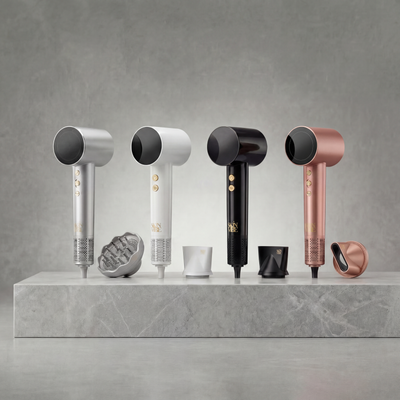
Aurea’s diffuser is wavy, with inner prongs: it separates strands better than a flat bowl and does a better job of reducing frizz in waves and curls. I’ll also be honest about what I hear from customers with long, thick curls: with hair past the shoulders, our bowl can be too shallow and the prongs too short to reach the roots. Hair like that is best dried in smaller sections than usual, and if your curl is really tight and long, look for a deep bowl with long fingers. Libra’s diffuser is classic and round, and it’s all you need for waves and loose curls. You put either of them on with one hand while the other holds the strand.

Which hair dryer should you choose for curly hair? Six criteria
A good hair dryer for curly hair has a diffuser in the box, a low temperature with cold air, adjustable airflow, ionization or plasma against frizz, low weight and quick nozzle changes. Wattage and the number of modes are secondary: curls are dried gently, not hard.
1. A diffuser in the box and its shape. Check whether it’s in the box, because that still isn’t standard, and what shape it is (see the table above). A diffuser bought separately is usually a universal diffuser, and that’s a compromise.
2. A low temperature and cold air. Curly hair is naturally drier at the ends and overheats faster, so heat it gently: 50-60°C is a comfortable range, and Polish dermatologist Marcin Zakrzewski advises not to exceed an air temperature of around 70°C. Trichologist Agnieszka Trepka says something similar in our podcast (in Polish): a maximum of 90°C, ideally around 70°C. In Aurea, the warm air is 55°C, and the alternating mode switches between 3 seconds of warm and 4 seconds of cold air by itself; in Libra, you choose 50 or 70°C and hold the cold air button at the end.
3. Adjustable airflow. A 110,000 rpm motor is an advantage with straight hair; with curls, you need a lower speed, because a stream that’s too strong breaks up the curl even through a diffuser. Aurea has two speeds, Libra three. One customer wrote in a review that Aurea is “a wonderful hair dryer for curly hair”, and then added: “precise setting required”. A spot-on remark: low speed, low temperature.
4. Ionization or plasma. Frizz is an open cuticle and electrical charges on the surface of the hair; negative ions neutralize them and close the cuticle. Libra generates 200 million negative ions per cm³, while Aurea works with plasma, a billion positive and negative ions per cubic centimeter of air. If your main problem is frizz, read how to choose a hair dryer with ionization and how plasma differs from ionization. To find out how open the cuticle of your hair is, take the hair porosity test, which tells you in a minute.
5. Weight and balance. You hold the diffuser still against your head for a minute or two per section, which means a quarter of an hour with your arm raised. Aurea weighs 410 g and Libra 420 g; with a hair dryer weighing more than half a kilo, your arm starts dictating the pace, and curls don’t like being rushed.
6. Nozzle attachment and cable. A magnet with 360° rotation means you can change the nozzle with one hand, without putting the hair dryer down. A 2.7 m cable lets you dry with your head tilted over the bathtub without pulling the plug out of the outlet. It sounds like a detail until you’re drying your curls standing at the mirror in a bathroom with one outlet.
The other criteria, from a brushless motor to noise level, are the same as for any hair dryer; I describe them in my guide to choosing a hair dryer.

How do you diffuse curly hair step by step?
Diffuse your hair in sections: place the strand in the diffuser bowl, lift it to the roots, hold still for a minute or two on a low temperature and low or medium airflow, then move on to the next strand. Finish with cold air and don’t touch your hair until it has cooled down completely. Separate the curls only once they’re dry, with your fingers.
- Remove water without rubbing. Use a cotton T-shirt or a microfiber towel and squeeze the strands from the bottom up, as if you were scrunching paper. A terry towel and vigorous rubbing open the cuticle and create frizz before you’ve even switched on the hair dryer.
- Product on wet hair. Curl cream, mousse or gel, spread through the strands and pressed upward with your palm. Detangle once, with your fingers or a wide-tooth comb, and don’t go back to the comb.
- Set the hair dryer before you bring it to your hair. A low temperature (warm 55°C in Aurea, 50°C in Libra), low or medium speed. Leave hot air and strong airflow to straight hair and the concentrator.
- Divide your head into 4-6 sections. Tilt your head down or to the side so the strands hang freely; with short hair, you can sit up straight and lift the strands with the diffuser from below.
- Strand in the bowl, bowl to the roots, and stay still. Place the ends in the diffuser, lift it to the roots and hold still for a minute or two. Here I’ll let a dermatologist speak: Marcin Zakrzewski advises placing the diffuser and holding it, not swinging the hair dryer from side to side. Then slowly move it away and take the next strand.
- Dry to 80-90%. Your hair should feel slightly cool to the touch, but with no drops of water. Leave the remaining moisture to the air: the ends won’t overheat, and the curls won’t go stiff.
- Cold air at the end. 20-30 seconds per section: it closes the cuticle and sets the curl. In Aurea, the alternating mode does this for you throughout drying; in Libra, you hold the cold air button.
- Hands off until it cools. Only then separate the curls with your fingers and soften the stiff layer of product by scrunching the strands with your hand. A brush destroys in ten seconds what you’ve been building for a quarter of an hour.
Move it or not? You’ll find both versions online, so let me settle it: at the strand, the diffuser stays still, and the only movement is slowly moving it to the next section. There is one exception, and it concerns the beginning: when your hair is very wet, you can hold the diffuser 15-20 cm from your head for the first two or three minutes, without touching the strands, to evaporate excess water and set the product, and only then move on to placing strands in the bowl. Drying on cold air alone from start to finish, which some guides also recommend, can take an hour and ends with flat curls: save cold air for the finish.
How long does it take? Diffusing is slower than drying with a concentrator: for shoulder-length hair, allow 10-15 minutes, for long, thick hair up to 20. Our customers with curly hair write that a powerful motor shortens this time (one of them went from 20 minutes down to 7), but with curls, I wouldn’t race the clock: every strand you let go too early will come back as frizz.
If you always air-dry your curls on principle, I have an argument for you that surprised even me. In a study published in the Annals of Dermatology, hair left to dry naturally for more than two hours had a more damaged layer that binds the fibers together than hair dried with a hair dryer held 15 cm away and kept constantly moving. During long contact with water, hair swells from the inside. A diffuser held still is a different technique from the one in the study, but the conclusion about water stands: the shorter the time your hair is wet, the better for its interior, provided you heat it gently.

The video is in Polish. After you click, YouTube (Google) plays the video.
What temperature and airflow for curly hair?
For curly hair, set 50-60°C (waves can take up to 70°C) and low or medium airflow; the tighter the curl and the finer the hair, the lower. Waves can take medium airflow and shorter diffuser holds, while tight curls need smaller sections and more time. Leave hot air at 80-90°C to the concentrator and straight hair, and not every day.
| Curl type | Temperature | Airflow | Time per section | Technique |
|---|---|---|---|---|
| waves, loose curl | 55-70°C | medium | 45-60 s | large sections, head tilted to the side, short cool finish |
| bouncy curls | 50-60°C | low or medium | 1-2 min | head down, strand in the bowl lifted to the roots |
| tight, small curls | 50-55°C | low | 1.5-2 min | small sections, deep bowl, don’t move away too fast |
| fine and delicate, any curl | 50-55°C | low | shorter, cold air more often | small sections, plenty of cold air, no touching |
| curly, color-treated or bleached | 50°C and cold | low | 1-2 min | heat protectant, cool finish longer than usual |
If you know the popular curl type chart: waves are roughly 2A-2C, bouncy curls 3A-3C, tight and small curls 4A-4C. I took these ranges from the settings of our hair dryers and from the recommendations I quoted above, but they’re a starting point, not a dogma. If your ends feel rough after drying, go one level lower; if your curls come out stretched, use smaller sections and hold still longer instead of turning up the temperature.

Seven mistakes that make diffused curls frizzy
Frizz after diffusing almost always comes down to one of seven things: swinging the hair dryer, too high a temperature, too strong airflow, touching or brushing wet curls, drying too briefly with moisture left inside the strand, a terry towel or too much product. None of the fixes requires new equipment, only patience.
- Swinging the diffuser. Every movement is a stream of air sliding along the strand, which means stretching the curl. Place it, hold it, move it away slowly.
- Too hot. Above 70°C, hair loses water faster than the curl can set; it comes out dry and dull. Go down to 50-60°C and give it a minute longer.
- Too strong airflow. Even through a diffuser, a high speed breaks up the strands from the inside. A low speed for curls isn’t a compromise, it’s the rule.
- Touching and brushing while drying. A wet curl remembers every touch as frizz. Fingers only once it has cooled.
- Stopping too soon. A strand that’s dry on the outside and wet inside will stretch out and frizz within an hour. Dry to 80-90%, checked in the middle of the section, not on the surface.
- A terry towel. Friction opens the cuticle before the hair dryer even starts working. A T-shirt or microfiber, squeezing instead of rubbing.
- Too much product. Curls come out heavy, “flat and sort of greasy”, as one viewer wrote under a video about diffusers. Use a walnut-sized amount of cream or gel for your whole head and spread it on wet, not damp, hair.
And if you don’t have a diffuser? It can be done, with a compromise: low speed, low temperature, the hair dryer 20-30 cm from your hair, head down, the stream directed from below toward the roots, not along the strands. The second option is a two-step dry: let your hair air-dry to 60-70% with curl product in, then finish the rest with cold air from a distance. There will be more frizz and less volume than with a diffuser, but less damage than with a concentrator. If you wear your curls every day, that’s an argument for a hair dryer with a diffuser in the box, not for yet another universal diffuser on an elastic band.
Diffusing short hair, bobs and men’s curls
On short hair, a diffuser works best without tilting your head: sit up straight, lift the strands with the diffuser from below and hold for 30-60 seconds, section by section. With a bob, watch the ends so they don’t catch on the diffuser’s fingers and get twisted into the bowl, or they’ll come out bent. For short men’s curls, one section on top and two at the sides are enough, a few minutes in total.
Short curls have one advantage: they dry quickly, so the temptation to turn up the temperature is smaller. They also have one trap: with short hair, a deep-bowl diffuser can be awkward, because the strands don’t reach the bottom and the air misses the roots. Here, a shallower diffuser with prongs, like our wavy one, is actually more comfortable, because you hold it almost flat against your head.
Root volume with a diffuser, even on straight hair
A diffuser also gives root volume to straight, fine hair: tilt your head down, hold the diffuser at the roots for 30-40 seconds per section on low airflow, and once you lift your head back up, finish with cold air. Your hair doesn’t lie flat, because it dried lifted. It’s three extra minutes in the morning and zero hairspray.
A customer with fine, delicate hair wrote to us that what she likes most about Libra is “the nozzle that gives my hair more volume”, and that’s exactly this trick. If you want to go further, in my guide to drying hair properly I also describe lifting the roots with the professional concentrator and drying against the direction of growth. And if what you’re after is volume in your ponytail alone, that’s not a job for a hair dryer, but for PonyGadget.
Aurea or Libra for curly hair? Which one for whom
Aurea, with its wavy diffuser, plasma and alternating warm-cold mode, is the choice for hair that frizzes a lot, is thick or is dried every day; with very long, tight curls, remember to use smaller sections. Libra, with its classic diffuser, ionization and three speeds, is enough for waves and loose curls. Nova has no diffuser, because we built it for the suitcase, not for curls. I’ve compared all three hair dryers, Nova included, in a separate article, Aurea, Libra or Nova. And if you want to see all our models with a diffuser in the box side by side, including the Nuvia hot air styler, we’ve gathered them in one place: hair dryers with a diffuser for curly hair.
Aurea Family x Plasma: 110,000 rpm motor, plasma, warm 55°C and an alternating mode of 3 s warm / 4 s cold, two speeds, 410 g, 59 dB, three magnetic nozzles with the wavy diffuser. Who is it for? Curly and thick hair, frizz-prone hair, and those of you who dry your curls every day and want to do it quietly, without overheating and without a sore arm.
Libra AirLoom: the same 110,000 rpm motor, ionization, four temperatures (cold, 50, 70, 90°C), three speeds, 420 g, a classic round magnetic diffuser. Who is it for? Waves and loose curls, hair that mainly needs calm and a cool finish, and those of you who want a SkinVibe hair dryer at a more affordable price; see Libra in our store.

Nuvia AirPlasma, our hot air styler, also has a Diffuser, which you attach magnetically to the Drying Nozzle. It’s the choice for you if you diffuse your curls but on other days want to smooth them with a brush or create waves with a curling barrel, all with one device. It won’t straighten tightly curled hair the way a straightener does, but it dries and styles with air of up to 90°C. Read more about how a hot air styler works, and on Nuvia’s product page.
Nova PlasmaGo is our small, 310-gram hair dryer for your handbag and suitcase. It has a concentrator, no diffuser, and Aurea’s attachments don’t fit it; if you travel with curls, read whether a travel hair dryer makes sense for your hair. Not sure which of our hair dryers suits your curl? A short quiz will match a model in a minute, and you’ll see all three in our hair dryer collection.
Frequently asked questions about hair dryers with a diffuser
Can you use a diffuser every day?
Yes, if you stick to a low temperature (50-60°C), low speed and a cool finish; a diffuser doesn’t hit your hair with heat from close up, so diffusing every day is gentle on curls. If your ends get rough, go one temperature level lower and dry to 80-90%, leaving the rest to the air.
Can you buy a diffuser separately for a hair dryer?
With our Aurea and Libra hair dryers, the diffuser is included, so you don’t need to buy one. If you have another brand’s hair dryer without a diffuser, check with its manufacturer whether they sell the diffuser separately as an accessory; drugstores also sell universal diffusers that attach with an elastic band: they fit many models, but they hold less securely and let air escape at the sides, so treat them as an emergency solution.
How do you diffuse curly hair so it doesn’t frizz?
Low temperature (50-60°C), low speed, the strand placed in the bowl and lifted to the roots, the diffuser held still for a minute or two, cold air at the end and no touching until it cools. Before that: squeezing with a microfiber towel instead of rubbing, and curl product on wet hair.
Is a diffuser suitable for straight hair?
Yes, but for one purpose: root volume. Head tilted, diffuser at the roots for 30-40 seconds per section, cool finish. A diffuser won’t create curls from straight hair; to smooth straight hair, use the concentrator.
How long should you diffuse your hair?
A minute or two per section, to 80-90% dry; for shoulder-length hair, that’s usually 10-15 minutes, for long, thick hair up to 20. Leave the remaining moisture to the air. A strand that’s dry on the outside but wet inside will frizz within an hour.
Which hair dryer is best for curly hair?
One that has a diffuser in the box, a low temperature with cold air, adjustable airflow, ionization or plasma, and is light: the closer to 400 g, the better, because you hold the diffuser still with your arm raised. From our range, for thick, frizz-prone curls I recommend Aurea with the wavy diffuser, and for waves and loose curls, Libra; with very long, tightly curled hair, pay attention to the depth of the diffuser bowl.
Which hair dryer for curly hair does a trichologist recommend?
In our podcast, trichologist Agnieszka Trepka doesn’t name a brand, only parameters: airflow no hotter than 90°C, ideally around 70°C, temperature control and a cool finish. For curly hair, I add a diffuser in the box and a low speed; these are criteria, not a name on the casing.
Can you dry curly hair without a diffuser?
You can, with a compromise: low speed, low temperature, a distance of 20-30 cm, head down and the stream directed from below toward the roots. There will be more frizz than with a diffuser, but less damage than with a concentrator.
Curls don’t like to be rushed. A diffuser does one thing for you: it gives them the time and calm to dry in their own shape. The rest is patience and keeping your hands away.
Anna Nowak-Ibisz, co-founder of SkinVibe