

Ionic hair straightener: what does it do, and is plasma the same?
Ionization in a straightener releases negative ions that neutralize the positive charge on hair, so it gets less static and looks shinier; the effect is real but subtle. Plasma adds positive ions as well. Temperature matters more: above 200°C a straightener starts to damage keratin.

“Ionic hair straightener” is one of those labels you see on almost every box, yet hardly anyone can say what the feature actually does. Three questions come up most often: Is it worth paying extra? Isn’t it just a marketing trick? And how does it differ from the plasma we write about in our product descriptions?
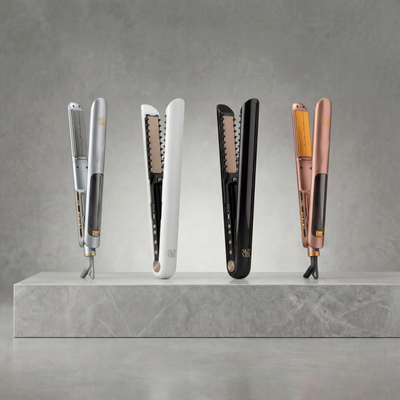
In twelve years of “Pani Gadżet”, my own show on Polish TV, a huge amount of hair equipment passed through my hands, and later I designed our straighteners together with our team. I founded the SkinVibe brand, so in this article I also write about our Astra, but first, honestly: what research says about ions, where the effect is real, and where physics ends and advertising begins.
IN SHORT
- Ionization in a straightener is the emission of negative ions, which neutralize the positive charge on your hair. As a result, strands get less static, are easier to style and reflect light more nicely.
- The effect is real, but subtle. Static comes mainly from friction and dry, hot air, so ions help, but they won’t replace good technique.
- Plasma means positive and negative ions at the same time, which balance the charges on the surface of the hair. Classic ionization produces only negative ions.
- Temperature matters more than ions. Above 200°C a straightener changes the structure of keratin, which is why adjustable heat starting at 140°C and a single pass do more for your hair than any feature on the box.
What is ionization in a hair straightener?
Ionization in a straightener is a feature in which the device produces negative ions, meaning air molecules with extra electrons. They land on positively charged hair and neutralize that charge. In practice, strands stop repelling each other, don’t “fly away” after straightening, are easier to comb and style, and their surface looks smoother.
It’s worth saying right away what ionization is not. Ions don’t straighten hair, don’t penetrate deep into the strand and don’t nourish it. The heat of the plates does the straightening, while ions work on the surface, on what you can see with the naked eye: static, frizz and shine. That’s why it’s best to think of ionization as a finishing touch, not the foundation of a straightener.
Where does static come from when you straighten your hair?
Static is the result of friction. When hair rubs against a comb, a brush, the plates or other strands, keratin gives up electrons and the hair becomes positively charged. Strands with the same charge repel each other, so they stand on end and stick to your face. Dry, hot air makes it worse, because in humidity the charge escapes faster.
Chemist Magdalena Wajrak of Edith Cowan University explains that during drying, keratin fibers lose electrons through the so-called triboelectric effect, that is, charging through rubbing (The Conversation). She writes about hair dryers, but the same physics applies to a straightener, because the plates and the comb also rub against the strands. A review published in the International Journal of Trichology plainly calls friction the main cause of frizzy hair (Gavazzoni Dias et al.).
This leads to something practical: static doesn’t depend only on the straightener. Shampoo, conditioner, a hat, a sweater and even the way you comb all add to it. If this bothers you after drying too, I’ve covered it separately in my guide on why static hair behaves this way and how to dry it.
What does ionization do in a straightener, and what does science not promise?
Ionization really does reduce static and frizz after straightening, and the smoother surface of the strands reflects light better, so hair looks shinier. That’s the most common and most credible benefit. There is no evidence, however, that ions protect color, heal split ends or help hair absorb conditioners, even though such promises are easy to find in product descriptions.
I like to talk about this honestly, because I prefer to know what I’m paying for myself. Magdalena Wajrak notes that theory supports negative ions neutralizing the charge, but the amount of ions in hair devices is limited by voltage, so the effect is likely to be subtle. In practice, the difference is most visible in winter, with fine hair and in dry, radiator-heated air. With thick, heavy hair in summer it can be barely noticeable.

There’s also an indirect benefit that hardly anyone writes about. When hair isn’t static and glides smoothly between the plates, you go back to the same strand less often. Every extra pass means another dose of heat, so fewer touch-ups mean less overheating. This is where ions help hair the most, even if not directly.
Where does a straightener get its ions: a generator or tourmaline?
Ions in a straightener are created in two ways. Most often a small generator does the work, applying high voltage to a thin electrode and ionizing the air around the plates. The second way is a plate coating with added tourmaline, a mineral that releases negative ions by itself. Both solutions produce the same kind of effect; they differ in scale.
You can often recognize a generator by a separate opening or slit near the plates through which the ions come out, and by the fact that the description lists it as a feature of the device. Tourmaline tends to appear in the description of the plate coating. Figures like “millions of ions” are hard to compare between brands, because each one measures them in its own way. What’s more reliable is how your hair looks after the first week of straightening.
Plasma vs ionization: are they the same thing?
No. Classic ionization produces negative ions that neutralize the positive charge on hair. Plasma, in the sense in which we use the word for our devices, means positive and negative ions produced at the same time. Their job is to balance the charges across the whole surface of the hair instead of neutralizing just one of them.
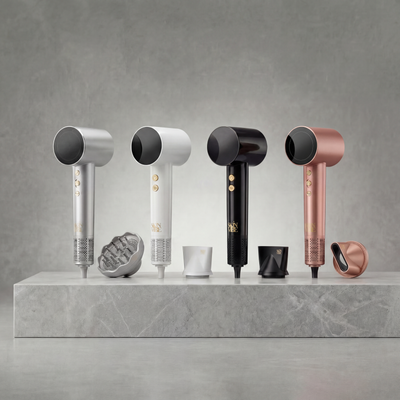
In our Astra SteamPlasma straightener, plasma means more than a million positive and negative ions per cubic centimeter. In hair dryers the scale is different: Aurea has 1 billion positive and negative ions per cubic centimeter, while Libra uses classic ionization, that is, 200 million negative ions per cubic centimeter. I’ve described the difference between these technologies for drying in my article on how plasma in a hair dryer works.
| Technology | What it produces | What you feel on your hair |
|---|---|---|
| Ionization | negative ions that neutralize the positive charge of hair | less static and frizz, easier combing |
| Plasma | positive and negative ions at the same time, which balance the charges | smooth, soft strands and a glassy finish |
| Tourmaline | a plate coating that releases negative ions | smooth glide, a milder effect than with a generator |
One sentence to avoid confusion in search results: the “plasma ionizer” in air conditioners and air purifiers is a completely different device, used to freshen the air in a room. The only thing it has in common with a straightener is the name. And there are no independent studies yet comparing plasma and ionization in hair devices, so the best measure remains what you see on your own hair.
Ionization, keratin, infrared, steam: what’s what?
On straightener boxes these labels stand side by side as if they were the same thing, yet each one means something different. Ionization and plasma are about charges on the surface of the hair. Keratin is an additive in the plate coating. Infrared is a way of heating. Steam is moisture for the strand at the moment of straightening. Temperature and steam do the most for your hair, and only then everything else.
| Label on the box | What it is | When it matters |
|---|---|---|
| Ionization | a device feature: negative ions | fine hair, static-prone hair, winter |
| Keratin | an additive in the plate coating | mainly plate glide; its effect on the hair itself is debatable |
| Infrared | the way the plates give off heat | even heating, but temperature counts just the same |
| Steam | moisture for the strand at the moment of straightening | dry, frizzy, colored hair; a lower temperature |
If you’ve had a keratin treatment at a salon, remember that it’s a completely different topic from “keratin” plates. I’ve described how to care for your hair after such a treatment, and what to straighten it with, in my guide on hair after keratin and nanoplasty. And in my article on what a steam straightener is, you’ll find out how exactly steam works at the plates.
Ionic straightener or not: who is it worth it for?
Ionization pays off most for hair that is fine, dry, bleached and prone to static, and also in winter, when the air at home is dry and hats and scarves do their part. For thick, healthy hair that doesn’t frizz, you can safely choose a straightener without this feature and spend the extra money on temperature control instead.
My simple rule goes like this: if after straightening your hair sticks to your face or single hairs stand out, ions will make a visible difference. If the problem is dullness and rough ends, look for steam and a lower temperature first. And if you don’t know what kind of hair you have, start by checking its porosity, because porosity tells you how much heat your strands can take. Our hair porosity test will help.
I’ve laid out how to choose the equipment step by step, from plates to safety features, in a big guide: how to choose a hair straightener. If you’d rather answer a few questions than read, the hair tool quiz will point you to a model matched to your hair.
More important than ions: temperature and plates
The most damage during straightening comes from too high a temperature, not from a lack of ions. A study published in the Journal of Cosmetic Science showed that straighteners working above 200°C can significantly damage keratin: its structure changes, the hair holds water less well and breaks much more often when combed (Zhou et al., J Cosmet Sci).
Another team, from the University of São Paulo, measured that from 200°C hair begins to release compounds that indicate protein breakdown, and keratin itself denatures at around 237°C (Lima et al., J Cosmet Dermatol). This isn’t a “safe threshold”, but the limit beyond which the damage can no longer be undone. The authors stress that temperature control matters most.

That’s why we gave Astra five settings, each for a different hair type: 140°C for delicate and bleached hair, 160°C for normal and colored hair, 180°C for curly hair, 200°C for thick hair that’s hard to style, and 220°C only for very dense and exceptionally stubborn hair. The plates are ceramic and heat evenly, so a single pass is usually enough. If you’ve ever overdone the heat, take a look at my article on how to recognize hair burned by a straightener and what to do about it.
How to straighten with ionization or plasma so it really works?
Ions and plasma work best on hair that is completely dry, detangled and protected with a heat protectant. Straighten thin sections with one calm pass from roots to ends, at the lowest temperature that gives you the effect. At the end, give your hair a minute to cool before you comb it or tie it up, because that’s when the style sets best.
- Hair must be dry. A damp strand under the plate starts to boil. The exception is steam from the straightener itself, which works differently from wet hair.
- A heat protectant before every straightening. In the study by Zhou and colleagues, protective products applied before straightening clearly reduced hair breakage.
- Thin sections, about 2-3 cm. A thick section doesn’t heat evenly, so it’s tempting to turn up the temperature or go over it a second time.
- One pass, without stopping. The plates shouldn’t stay in one spot for longer than a few seconds.
- Cooling before combing. Warm hair is pliable and easily loses its shape. Once cool, it holds a straight line and gets less static when combed.
One more thing that makes a big difference with static: a comb or a natural-bristle brush instead of plastic, and combing before straightening, not right after it. Less friction means fewer charges, so the ions have less work to do.
Frequently asked questions about ionic hair straighteners
Does a hair straightener need ionization?
It doesn’t. A good straightener starts with plates that heat evenly, temperature control from about 140°C and automatic shut-off. Ionization is a valuable extra for fine, dry and static-prone hair. If your hair doesn’t frizz, it’s better to pay extra for temperature control than for ions alone.
Does ionization damage hair?
No. Negative ions work on the surface of the hair and neutralize the charge; they don’t heat the strand or change its structure. What damages hair during straightening is too high a temperature, straightening damp strands and passing over the same spot again and again. Ionization can even help indirectly, because smoother strands need touch-ups less often.
How can you tell that ionization in a straightener is working?
By the effect on your hair: after straightening, strands don’t stick to your face, single hairs don’t stand out, and the comb glides smoothly. You can see it best in winter and with fine hair. Some straighteners have a separate ion generator opening near the plates or an indicator for the feature on the display, but you’ll judge the effect itself most reliably after the first week of use.
What’s better in a straightener: ionization or keratin?
They’re two different things, so you don’t have to choose. Ionization is a device feature that reduces static. Keratin is an additive in the plate coating that mainly improves their glide, and its effect on the hair itself is debatable. If I had to pick the one feature that matters more, I’d choose temperature control, and among the extras, ions, plasma or steam.
Does an ionic straightener protect hair color?
There’s no evidence that ions alone protect color. What harms colored hair most is high heat, which dries out the strands, so with colored hair it’s more important to straighten at a lower temperature, for example 160°C, and to use a heat protectant. Ions will improve how the surface looks, but they won’t replace these two rules.
Is plasma in a straightener better than ionization?
Plasma produces positive and negative ions at the same time, so it balances the charges across the whole surface of the hair instead of neutralizing just one of them. On your hair, this translates into smoothness and a glassy finish. There are no independent studies comparing the two technologies yet, so, just as with ionization, the best measure is your hair after a few straightenings.
Finally, the most important thing: ions are a nice extra, but your hair remembers temperature above all. Start with the lowest setting that gives you the effect, and treat the features on the box as the icing on the cake.
Anna Nowak-Ibisz, co-founder of SkinVibe