

Steam hair straightener: how does it work, and is it worth it?
A steam straightener releases a fine water mist exactly when the plates apply heat, so you get smooth hair at a lower temperature and with less friction. Steam doesn’t damage hair; too much heat and straightening wet hair do. It makes most sense for dry, frizzy, colored hair straightened often.

When I was testing straighteners on Pani Gadżet, a Polish TV show, a “steam” straightener sounded like a tool for hairdressers: expensive, temperamental and always raising the question of whether it was really just a clothes iron for hair. Today, steam is one of the most common questions I get about straighteners, and the answers online are either straight out of a catalog or evasive.
So I’ll answer the way I answer my friends: in plain language and with numbers. What steam does to hair, what it doesn’t do, when it’s really worth paying extra for it, and when good ceramic plates are enough. I know this topic from the inside: I founded the SkinVibe brand, and our Astra SteamPlasma straightener combines steam with plasma, so I’ve had time to check how much of this technology is effect and how much is promise.
IN SHORT
- A steam straightener releases a fine water mist while you straighten, which moisturizes the strand exactly when the heat is acting on it. The effect: better glide, less frizz and smoothness at a lower temperature.
- Steam doesn’t damage hair. Too high a temperature and straightening wet hair do, and steam has as much in common with the latter as a mist has with a puddle.
- Steam makes the biggest difference with hair that is dry, frizzy, colored and straightened often. Healthy hair that you straighten occasionally will do fine with good ceramic plates.
- When choosing, look at: the steam rate (a mist, not a cloud), whether the steam can be switched off, temperature control with a low starting point, ceramic plates and a clear display.
- Don’t know where to start? My hair tool quiz has a separate path for straighteners.
How does a steam straightener work?
A steam straightener has a small water tank in the handle. When you switch on the steam function and guide the plates along a strand, the device heats the water and releases a fine mist through a valve next to the plates. The hair gets a controlled dose of moisture exactly when the heat is acting on it: the plates glide more smoothly, and the strand smooths out at a lower temperature than “dry”.
Quantity matters, because the word “steam” itself is misleading. In our Astra, the tank holds 12 ml, and steam is released at a rate of 0.7-1.2 g per minute. It’s literally a mist, not a cloud like from a clothes iron: at this rate, 12 ml is enough for about 10-17 minutes of steaming, so for a full styling session. The steam doesn’t pour out like from a kettle: it’s a quiet hiss you can hear as you guide the plates along the strand, a sign that the valve is releasing moisture and the function is working properly.
What does this do for your hair? Four things you can see after the first straightening: the strands are better moisturized and more elastic, they don’t frizz after straightening, they’re less exposed to overheating, and they get a smooth, mirror-like, glassy finish that until now was associated mainly with the salon. Moisture also improves the glide of the plates, so there’s less friction and less mechanical damage.

Steam straightener or classic straightener: how are they different?
A classic straightener works with the heat of the plates alone. A steam straightener does the same, but adds moisture while the heat is acting, so you achieve the same effect at a lower temperature and with less friction. You can see the difference at the ends and in the frizz, especially with dry and colored hair.
| What we compare | Classic straightener | Steam straightener |
|---|---|---|
| What acts on the hair | the heat of the plates alone | heat plus a water mist |
| Temperature needed for smoothness | higher | lower for the same effect |
| Plate glide | depends only on the plates | better thanks to the moisture |
| Frizz after styling | more common with dry hair | less |
| Use | you switch it on and straighten | you top up the water before styling |
| Enough for | healthy hair, occasional straightening | dry, frizzy, colored hair, straightened often |
Does a steam straightener damage hair?
No, steam itself doesn’t damage hair. What harms hair is too high a temperature and straightening before it’s completely dry. Steam works the other way: it lets you get smoothness at a lower setting and reduces the friction of the plates, so at a sensible temperature, a steam straightener is gentler on hair than a classic one set to “full blast”. I’ve described how heat damage differs from dryness, and how to save hair after straightening that was too hot, in my article on hair burned by a straightener.
When it comes to temperature, the numbers are fairly clear. In a study published in the Journal of Cosmetic Science, straightening above 200°C changes the structure of keratin and worsens the hair’s ability to retain water, while protecting the hair beforehand clearly reduces breakage. Trichologist Agnieszka Trepka says it plainly in our podcast (in Polish): settings above 210°C are too much for hair, unless you protect it with heat protection. That’s why in Astra, we kept the highest setting, 220°C, only for very thick hair that is exceptionally hard to style, and most of you will never touch it.
There’s also a second culprit that steam is often wrongly blamed for: straightening wet or damp hair. I explain why it’s the worst-case scenario in the next section.
Can you straighten wet hair with a steam straightener?
No. A steam straightener, just like a classic one, is for dry hair or at most slightly pre-dried hair. Agnieszka Trepka repeats this plainly in our conversation: straightening must be done on thoroughly dry hair, and straightening damp hair is a mistake. Physics confirms it: in a study on how water affects heat damage to hair, a straightener on strands wetted with water caused the same chemical changes as on dry ones, but much greater structural damage, and the culprit was the violent evaporation of water from the hair. Thermal measurements from the University of Manchester add a second number: the keratin proteins of wet hair start to denature at around 150°C, while those of dry hair only at about 230°C. Steam in the device doesn’t change anything here, because it adds moisture to the surface of the strand in a microscopic dose and doesn’t heat water trapped inside the hair.
So the practical order is always the same: first dry your hair with a hair dryer, then a heat protectant, and only then the straightener. In this order, steam makes sense. I’ve described how to dry without overheating in my guide to drying your hair properly.
What hair does a steam straightener make sense for?
Steam makes the biggest difference with hair that is dry, frizzy, colored and straightened often, meaning where every reduction in temperature and every reduction in friction is a real saving for your hair’s condition. With healthy, not particularly dry hair that you straighten only on special occasions, good ceramic plates at a sensible temperature are more than enough, and there’s no point paying extra for steam. A separate case is hair after a keratin treatment and nanoplasty; I’ve described whether steam harms it and how to dry and straighten it then in my article on keratin and nanoplasty aftercare. Dry, frizzy and colored hair is most often high porosity hair, and you can check it in a minute by taking the hair porosity test.
Temperatures show it best, because they’re what decides. On Astra, we matched the five settings to hair types: 140°C for delicate and bleached hair, 160°C for normal and colored, 180°C for curly, 200°C for thick and hard-to-style, 220°C for very thick and exceptionally resistant hair. Steam lets you start on a lower setting and often stay there. If your hair is fine or bleached, steam at 140-160°C is exactly the scenario in which a steam straightener is most “for you”.
Curly and thick hair benefit too, just differently: steam improves the glide, so the strand doesn’t get tugged at the plates, and every tug is mechanical damage that no conditioner can undo afterwards.

How to use a steam straightener: six rules
- Only dry hair. Washed, dried, detangled. Don’t straighten damp hair, not even with a steam straightener.
- Water for the tank: clean or distilled. Limescale from hard water builds up in the steam channels and weakens the steam over time. Only water goes into the tank: no oils or conditioners. We include a refill bottle with Astra. Fill the tank with the device switched off, and before switching it on, check that the housing around the filler opening is dry.
- Heat protectant before, not instead. A heat protectant product and steam are two different layers: one protects the hair from the heat itself, the other reduces friction and lets you lower the temperature. They work best together.
- Start with the lowest temperature that gives results. The assignment of temperatures to hair types in the section above is a starting point, not a rule; if the strand is smooth at 160°C, there’s no reason to go higher.
- Narrow sections, one smooth movement. Close the plates on the strand and guide the straightener from roots to ends without stopping; a quiet hiss is a sign that the steam is working. Stopping in one place means local overheating, with or without steam.
- After styling, put the straightener down on the heat-resistant mat (it comes in the set with Astra) and switch it off, instead of relying on the automatic shut-off after 30 minutes. Only put it into the pouch once it has cooled.

Which steam straightener should you choose? Six things to check
If steam makes sense for your hair, look at six things when choosing a specific model:
- Steam rate and tank. Look for a mist, not a cloud: for comparison, Astra releases 0.7-1.2 g per minute with a 12 ml tank. More steam doesn’t mean better; the point is controlled moisture on the surface of the strand, not soaking the hair.
- Being able to switch off the steam. A good steam straightener also works like a classic one: when flipping the ends and on days when you don’t top up the water.
- Temperature control with a low starting point. Look for a scale that starts at around 140°C and has several clear settings, not a single one. A model that starts high is too hot for delicate and bleached hair, with or without steam.
- Plates. Ceramic heats evenly and gives a smooth glide without tugging; combined with steam, it’s the gentlest duo for the ends that I know.
- Display and heat-up time. An active-steam icon and a clear temperature on the screen save you the guesswork. Astra heats up in 28 seconds, so you switch it on and straighten instead of waiting.
- Ergonomics: weight, cord and what’s in the box. A lighter straightener means a less tired arm with long hair (Astra weighs 376 g without the cord), a 2.7 m swivel cord doesn’t twist at the mirror, and a heat-resistant mat and a refill bottle in the set are small things you notice every day.
Before you decide, also read my full guide to choosing a hair straightener: plates, width, safety and technique, without which no steam will help.
Our Astra SteamPlasma: steam and plasma in one
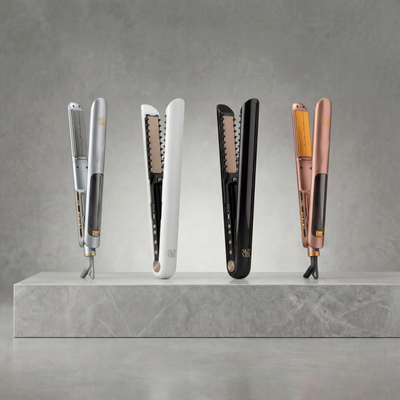
Astra SteamPlasma combines steam with plasma technology: more than a million positive and negative ions per cm³, which stabilize the charges on the surface of the hair, so the strands are smooth, soft and shiny and don’t get static after styling. Steam moisturizes and improves the glide, plasma seals and smooths; together they give a glassy finish that until now was associated mainly with the salon. On top of that: ceramic plates, five temperatures from 140 to 220°C, a 28-second heat-up, an LCD display with a steam icon, a 2.7 m cord with 360° rotation and automatic shut-off after 30 minutes.
Who is it for? For those of you who straighten often, have dry, frizzy or colored hair and want to lower the temperature without losing the effect. If you straighten occasionally and only touch up your hair while traveling, our cordless Luna MiniWireless, without steam, is often the more sensible choice; I’ve written separately about when a cordless straightener is a convenience and when it’s a compromise. And if you’re torn between models, the hair tool quiz will show you after a few questions which one suits your hair. You’ll see all SkinVibe steam and cordless straighteners in one collection.

The video is in Polish. After you click, YouTube (Google) plays the video.
Frequently asked questions about steam straighteners
Is a steam straightener better than a regular one?
For hair that is dry, frizzy, colored and straightened often: yes, because it gives smoothness at a lower temperature and with less friction. For healthy hair straightened occasionally, the difference is smaller, and good classic ceramic plates are enough. So “better” depends on the hair, not on the label.
Which straightener is healthiest for hair?
One that lets you straighten at the lowest effective temperature and doesn’t tug the strand: temperature control starting at around 140°C, ceramic plates with a good glide and, with dry or colored hair, steam. What you do matters just as much: dry hair, a heat protectant, one smooth movement.
What water should you put in a steam straightener?
Clean or distilled water, and only water: no oils, conditioners or other liquids. Hard tap water leaves limescale, which builds up in the steam channels and weakens the steam over time. With Astra, you fill the tank from the included bottle, always with the device switched off.
Can you curl your hair with a steam straightener?
Yes. Besides straightening, Astra does ends turned under, gentle curls and waves, with or without steam. The technique is the same as with a classic straightener; steam simply adds smoothness and protection against frizz. I’ve described it step by step in my guide how to curl hair with a straightener.
Does a steam straightener work without water?
Astra does: you switch off the steam function with one button, and the device works like a classic straightener with ceramic plates and plasma. With other models, check this before buying.
What damages hair more: a hair dryer or a straightener?
A straightener works in direct contact with the hair at temperatures of 140-220°C, a hair dryer with an airflow that on a sensible setting is 50-70°C. So it’s the straightener that needs more discipline: dry hair, a heat protectant, the lowest effective temperature, one smooth movement. Neither device damages hair on its own; misuse does.
How often can you use a steam straightener?
The same as a classic one, ideally not every day. Steam lowers the temperature needed for the effect, but it doesn’t cancel the rule of “the lowest effective temperature and a single pass”. If you straighten several times a week, choose a lower setting, use a heat protectant and leave days without heat.
To put it as simply as I can: steam isn’t magic, and it isn’t a gimmick. It’s controlled moisture at the moment the heat acts, thanks to which you lower the temperature and stop fighting frizz. If your hair needs it, you’ll feel the difference the first time you straighten. If it doesn’t, don’t let anyone convince you that you have to.
Anna Nowak-Ibisz, co-founder of SkinVibe