

Professional hair dryer: what sets it apart and how to choose
A professional hair dryer differs from a home one in its workload: hours a day, not minutes. Choose by the motor (a brushless BLDC lasts up to 10,000 hours), weight (400-650 g), noise (below 70 dB), an easy-to-clean filter and a cable of at least 2.5 m.

In more than 30 years of working in front of the camera, I’ve spent more hours in salon chairs than I can count. And even before I founded the SkinVibe brand, I watched the tools professionals work with: what heats up, what feels heavy in the hand, what’s so loud you can’t hold a conversation.
Today I look at this topic from both sides of the mirror. On one side, you write to me looking for a hair dryer that will give you salon results at home. On the other, salons, beauty studios and stylists get in touch with us, asking about our devices for professional work. It’s a good moment to set out what a professional hair dryer really is: it comes down to the motor, weight, noise and hygiene, not the word “professional” on the box.
IN SHORT
- A professional hair dryer differs from a home one in the workload it’s built for. It has to keep going for several hours a day, not a few minutes.
- The motor is the heart of the matter. A classic AC motor (approx. 20,000 rpm, a lifespan of 500-1,500 hours) is cheap and simple to replace. A brushless BLDC motor (80,000-110,000 rpm, up to 10,000 hours) is quieter and lighter, and lasts many times longer.
- Weight: the comfortable range is 400-650 g. The lighter it is, the less tired your wrist is after a full working day.
- Noise: below 70 dB is comfortable to work with. Long, repeated exposure to 85 dB and more can damage your hearing.
- Do you run a salon or work on the go? We have a wholesale partnership program for professionals.
How is a professional hair dryer different from a home one?
A professional hair dryer is a device built to work for several hours a day: it has a more durable motor, a lighter and better balanced design, quieter operation and a filter that’s easy to clean. What sets it apart from a home hair dryer isn’t the “wattage”, but durability and ergonomics in daily, intensive use.
An ordinary hair dryer runs for 5-10 minutes a day at home. In a salon, the same device runs for hours: client after client, section after section. At that pace, everything that’s a detail at home becomes a deciding factor. A motor that overheats dies within a few months. Two hundred grams of extra weight turns into forearm pain by the evening. And a whistling airflow is as tiring after eight hours as standing on your feet.
There’s also another side to this line that people talk about less often: the best consumer hair dryers with brushless motors now have specs that, just a few years ago, people envied salon equipment for. The line is blurring, and that’s exactly why it’s worth choosing by the specs, not by the label.
The motor: AC or brushless BLDC?
A classic professional hair dryer has an AC motor (brushed, alternating current, an older generation): it spins at around 20,000 rpm, usually lasts 500-1,500 hours of use, mostly weighs 500-700 g and is loud, in the 80-90 dB range. It does, however, have two undeniable advantages: price and simplicity. In many salons it’s still the standard, bought more or less as a consumable: when it breaks, it’s replaced with a new one.
A BLDC (brushless) motor is a different philosophy. Speeds of 80,000-100,000 rpm, up to 110,000 in top models, a lifespan of up to 10,000 hours, a weight in the 400-650 g range and a noise level that drops to 59-70 dB in the best designs. In practice: at three hours of drying a day, an AC motor at the lower end of its lifespan wears out in a few months, and at the upper end in about a year and a half. At the same pace, a BLDC motor works for years: fewer trips to the repair shop, fewer surprises in the middle of the day, less electronic waste.
At home, the same logic works the other way round: you dry your hair for less time, so an AC motor is “enough”. Except that lightness, quiet and drying speed aren’t professional privileges. That’s why in my full guide to choosing a hair dryer I’ve long been saying: it’s the motor that makes the difference you feel every morning.
Weight and balance: you feel it after eight hours
Next to “quiet”, “light” is the most common wish I hear when we talk about equipment for work. No wonder: a professional hair dryer can spend several hundred hours a year in your hand. The comfortable weight range is 400-650 g, and the rule is simple: the lighter, the better, as long as the design stays well balanced.
This isn’t an imaginary problem. In a review of studies on hairdressers’ occupational health published in the Journal of Occupational Medicine and Toxicology, 28-60% of respondents reported shoulder complaints within a year, and 11-53% hand or wrist complaints; the risk factors it explicitly lists include working with your arms raised above shoulder level and repetitive movements. And a hair dryer is the tool that spends the most time in that position. On industry forums, the pain threshold even has a very specific value: “I’d prefer it to weigh up to around 500 g”, writes one of the hairdressers on a Polish industry forum, and another user adds that her arm only stopped hurting after she switched to a light hair dryer.
Because weight is only half the truth. The other half is balance, meaning how the weight is distributed between the handle and the head. A device that’s heavy at the head forces constant tension in your wrist, even if it looks harmless in a spec table. That’s why, before buying one for work, it’s worth simply holding the hair dryer: a minute or two, in the position you really work in, with your elbow raised. Your hand will tell you the truth faster than a table.
Noise: several hours a day in decibels
At home, the noise of a hair dryer is a matter of comfort. In a salon, it’s a matter of health and service quality at the same time. The US institute NIDCD states that long or repeated exposure to sounds of 85 dB and above can lead to permanent hearing damage, and classic AC hair dryers run in the 80-90 dB range. Eight hours a day in surroundings like that is a strain that builds up over the years.
We also have Polish data from salons themselves: in measurements by CIOP-PIB, Poland’s Central Institute for Labour Protection, in hairdressing and beauty salons, a handheld hair dryer generated an equivalent level of 78 dB, peaking at as much as 94 dB, and hair dryers were identified as the main source of noise in this work. Poland’s National Labour Inspectorate, in turn, offers a simple rule of thumb: if you can’t easily hear a client from a meter away while you work, it’s time to reach for quieter devices.
There’s a softer side too: at 60-65 dB you can talk freely, and the conversation at the chair is half of a visit to the hairdresser, after all. A hair dryer you have to raise your voice over tires out both the client and the team. That’s why I treat below 70 dB as the comfort threshold, and values around 60 dB as the class in which noise stops being an issue.
Hygiene, filter and cable: small things that grow at work
A few things you rarely think about in the store, but deal with every day at work:
Air filter. In a salon, a hair dryer sucks in not only air but also hair clippings, dust and hairspray mist. A clogged filter means weaker airflow, overheating and a shorter motor life. A filter you can remove without tools, a magnetic one for example, can be cleaned in a few seconds between clients, so it actually gets cleaned.
Cable. For work at a styling station, it’s worth having a cord of at least 2.5 m. A shorter one forces you to work in an awkward position or dance around the socket, and with dozens of blow-dries a week, that really matters.
Nozzles. A concentrator is the basis of precise styling, and a diffuser saves curls and waves. At work, the way they attach matters too: magnetic nozzles change with one movement, without wrestling with a hot tip.

What to check before you buy: a checklist for the salon and for home
Buying checklist
- Motor: the type (AC or BLDC) and the declared lifespan in hours, not just the wattage.
- Weight and balance: 400-650 g; hold the device in your working position.
- Noise: the real dB from the product page; below 70 dB = comfort all day long.
- Filter: removable without tools, easy to clean every day.
- Cable: at least 2.5 m for work at a styling station.
- Nozzles: a set that fits what you do most often (concentrator, diffuser), ideally magnetic.
- Warranty and service: a tool that works every day needs support behind it, not just a receipt.
Our hair dryers in professional hairdressing: an honest take
I’ll tell you straight: my team and I designed our hair dryers with the home in mind, not ten stations running nonstop. If you run a large salon where the hair dryers run from opening to closing, classic AC salon equipment bought more or less as a consumable can still be a rational choice, and I won’t try to convince you otherwise.
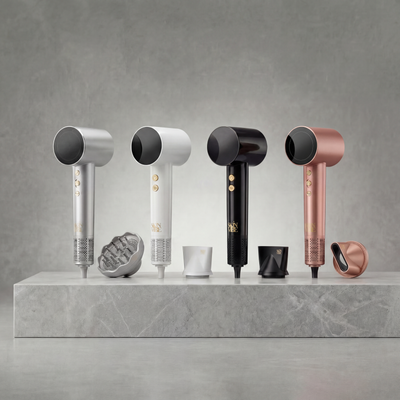
But there’s a sizeable part of professional work in which our designs hold their own on specs, not promises. Aurea Family x Plasma has a 110,000 rpm brushless motor, weighs 410 g and runs at 59 dB, and its touch sensor switches it off by itself when you put it down and wakes it up when you pick it up: in a “dry, put down, cut, dry” rhythm, that’s a feature you appreciate after the first day. Add to that three magnetic nozzles, a magnetic filter and a 2.7 m cord. Who is it for? For beauty studios, makeup artists and stylists who dry hair several times a day and need quiet next to the client, and for any of you who want a tool at home of the class used at work.
Our second star is Nova PlasmaGo: it weighs 310 g, with the same type of motor and the same rotational speed as Aurea. Who is it for? For mobile stylists and makeup artists who carry their whole kit in a bag and count every gram, and for finishing off a blow-dry and touch-ups between stations. I’ve compared both hair dryers spec by spec on our comparison page, and you’ll find all our ionic and plasma hair dryers in one collection.

The video is in Polish. After you click, YouTube (Google) plays the video.
Partnership for salons and stylists
More and more salons, studios and hairdressing schools are writing to us, so we’ve built a separate path for them: dedicated wholesale prices, quick contact and terms suited to business purchases. You’ll find the details and the form on our wholesale partnership for salons page.
There’s also a path the best salons know about: recommendation. A client whose hairdresser shows her what to dry her hair with, and how, can get that result again at home. If you work with our equipment and want to recommend it to others, as part of the wholesale partnership we can also talk about reselling at the chair.
Frequently asked questions about professional hair dryers
Which hair dryer do hairdressers recommend?
Instead of a specific brand, professionals usually point to a set of features: low weight with good balance (400-650 g), noise below 70 dB, a motor suited to the intensity of the work (BLDC for daily drying over many hours), an easy-to-clean filter and a cable of at least 2.5 m. These are criteria you can check on any product page.
How is a professional hair dryer different from a regular one?
In the workload it’s built for. A professional hair dryer has to withstand several hours of work a day, so what matters most is motor durability, low weight, bearable noise and filter hygiene. Wattage tells you the least about this: two hair dryers with identical wattage can be years apart in lifespan and half a scale apart in comfort.
How much should a professional hair dryer weigh?
The comfortable range is 400-650 g, and the closer to the lower end, the better for your wrist, as long as the design is well balanced. In professional work, a difference of a hundred grams that you won’t notice in the store becomes, after eight hours, the difference between fatigue and pain.
Which hair dryer damages hair the least?
One that doesn’t overheat it. Trichologist Agnieszka Trepka says on our podcast (in Polish) that the safe maximum for drying is around 90°C, and the ideal is around 70°C. In practice, look for a hair dryer with real temperature control (ideally with a sensor that measures it continuously), dry with movement and at a sensible distance, and treat technologies that close the hair cuticle, like ionization or plasma, as a valuable extra, not magic.
Is a home hair dryer suitable for a salon?
Increasingly, yes, provided we’re talking about a design with a brushless motor and the specs from the checklist above, and the workload is moderate: a beauty studio, mobile work, a few blow-dries a day. For continuous work at many stations, salon-grade equipment with service support remains the safer choice. I write more about the technologies themselves, including ionization, in separate guides.
The most common mistake when choosing a work tool? Making do with a stopgap. A good tool doesn’t have to be the most expensive, but it does have to be chosen consciously: by the motor, weight, decibels and filter, not by the label on the casing.
Anna Nowak-Ibisz, co-founder of SkinVibe