

How to choose a hair dryer in 2026: what to look for
Choose a hair dryer with a brushless (BLDC) motor, ionization or plasma, temperature control in the 50-80°C range with cool air, a noise level below 70 dB, a weight of 400-650 g and a concentrator plus diffuser in the box. A practical guide by Anna Nowak-Ibisz, co-founder of SkinVibe.

Hi, it’s Anna Nowak-Ibisz. We buy a hair dryer once every few years, but we use it almost every day. A bad choice means years of small compromises: mornings with frizzy hair, noise that wakes up the whole house and an arm that aches after a few minutes. Make a good choice and the problem is off your mind. Hair styled, the house still asleep, coffee still warm.
In twelve years of hosting “Pani Gadżet”, my own show on Polish TV, I tested more devices than I can count. And when, starting in January 2024, we were building SkinVibe, we tested more than 50 hair dryers and straighteners from other manufacturers before we showed our own in March 2025. So I know exactly what sets a truly good device apart from an average one. And I know you don’t need an engineering dictionary to make the right choice. You need a few specific numbers and a bit of common sense.
This guide is everything I check myself before any hair dryer makes it into my bathroom.
TL;DR. How to choose a hair dryer
- Motor. The new generation with a BLDC (brushless) motor, reaching as much as 110,000 rpm in top models, dries several times faster and lasts for years. Classic motors are slower, louder and wear out sooner.
- Care. Ionization reduces static and frizz. Plasma goes a step further, because it also works on moisture, shine and hair structure.
- Temperature. Look for temperature control in the 50-80°C range and cool air. Higher settings open the cuticle and weaken the hair.
- Comfort. A noise level below 70 dB and a weight in the 400-650 g range (the lighter, the better) are everyday comfort, not a luxury.
- Nozzles. A concentrator for smoothing, a diffuser for curls. Magnetic mounting means you’ll actually use them.
What should you look for in a hair dryer?
When choosing a hair dryer, six things matter: the type of motor, the care technology (ionization or plasma), temperature control with cool air, noise level, weight and ergonomics, and the nozzles included. Price and looks matter too, but it’s these six parameters that decide whether you’ll still be happy with your purchase a year from now.
Sounds technical? Don’t worry. Below I break each of these points down and explain what it means in practice. The specs on a product page are a bit like the ingredient list of a face cream: everything is written there, but only knowing what to look for turns it into real information.
One tip to start: don’t begin with the price. Begin with your hair and your mornings. Someone with thick, waist-length hair chooses differently from someone with a fine bob, and a mom who dries her own hair and her kids’ hair chooses differently again. That’s why further down you’ll also find how to match a hair dryer to your hair type.
Classic hair dryer or new generation? The most important decision
Today the hair dryer market splits into two groups: classic designs with a brushed (AC) motor and new-generation devices with a brushless motor, labeled BLDC. A classic motor turns about 20,000 times a minute, a brushless one in top models as much as 110,000. That one difference affects drying time, noise, weight and how long the device lasts.
A brushless motor (BLDC stands for brushless DC) has no parts rubbing against each other. In practice this means three things: it runs much faster, heats up less and wears out more slowly than brushed designs, whose rubbing parts simply wear down over time. That’s why new-generation hair dryers come with lifespan claims counted in years, not seasons.
Where does the difference in drying time come from? High speed creates a fast, focused airflow that literally blows the water off your hair instead of evaporating it with high heat. That’s why new-generation dryers dry faster at a lower, safer temperature. Our Aurea, at 110,000 rpm, reaches an airflow of 25.367 m/s and dries short hair in 29 seconds. Long, thick hair takes 5-7 minutes instead of a quarter of an hour.
There’s one more bonus hardly anyone talks about: weight. A brushless motor is small and light, so the whole device can weigh 400-450 g instead of 600-700 g. And those heavier, weaker models take longer to dry - and after a few minutes their weight stops being a number in a table and becomes a feeling in your forearm. A light, powerful dryer finishes before you have time to feel it.
How do you spot the new generation on a product page? Look for the words “brushless”, “BLDC” or “brushless DC” and for a motor speed counted in tens of thousands of revolutions per minute.
How many watts should a good hair dryer have?
How many watts should a hair dryer have? For a modern brushless one, 1100-1600 W is enough; classic ones need 2000 W and more, because they make up with heater power for what the motor lacks. Wattage mostly tells you how much electricity the heater draws, not how fast your hair will dry. Drying speed depends on the airflow, meaning the motor speed and the air speed in m/s. A modern 1500-1600 W dryer can dry faster than a classic design rated at over 2000 W.
So instead of looking for the highest wattage, check two other items on the product page: the motor speed (RPM, revolutions per minute) and the airflow speed in m/s or km/h. Our Aurea is rated at 1600 W, but its speed comes from the motor: 110,000 rpm and an airflow of 25.367 m/s. In practice: short hair is dry in 29 seconds, and drying long hair in the morning takes a few minutes, not a quarter of an hour.
And what about the electricity bill? Let’s do the math: a 1600 W dryer running for 6 minutes uses about 0.16 kWh, roughly as much as boiling one full kettle of water. Even if you dry your hair every day, that adds only a little to your monthly bill. Heater power won’t ruin your bills; the wrong temperature, on the other hand, can ruin your hair, more on that in a moment.
Ionization and plasma: what do they really do to your hair?
Ionization is the emission of negative ions that neutralize static charges on the hair: they reduce frizz, make styling easier and help close the hair cuticle. Plasma goes a step further, because it emits negative and positive ions at the same time, so besides static it also works on moisture, shine and volume. I wrote about the winter version of this problem, hair that gets static under a hat, in my article static hair: why it happens and how to dry it.
When we were analyzing search engine data while working on the brand, one thing surprised me: lots of us search for an “ionic hair dryer”, but only a few ask what ionization actually does. We buy the slogan on the box without knowing what’s behind it. And it’s worth knowing, because the differences are real and you can feel them on your head.

Ionization in a nutshell: when a stream of air rubs against wet hair, the strands become charged and repel each other, hence frizz and “flyaway” strands. Negative ions neutralize these charges, and a closed hair cuticle keeps moisture inside. In practice, hair is smoother, calmer and easier to detangle. In our Libra, ionization means 200 million negative ions per cm³, which do exactly this job.
Plasma works more broadly. It emits negative and positive ions at the same time, in our Aurea a total of one billion ions per cubic centimeter of air. To put it simply: ionization tames static, while plasma also takes care of moisture, shine and hair structure. Plasma is also the subject of scientific research, including in the context of hair health. In our comparative measurements of Aurea, plasma meant 138.5% higher hair elasticity, 65% more shine, 42% more strength and 49% better color retention.
Does every one of us need plasma? No. If your hair gets moderately static, good ionization is more than enough. Plasma makes sense for hair that frizzes a lot and for colored or dried-out hair. If you want to go deeper, I write about what ionization does in a hair dryer and how it differs from plasma in a separate article. And if you’re looking specifically for a hair dryer with ionization, I have a separate guide for you: how to choose one, which numbers to look at and when it isn’t worth paying extra.
Temperature: why more doesn’t mean better
A safe hair drying temperature is about 50-70°C. Above 75-80°C, changes begin in the hair structure that no conditioner can undo: the cuticle opens, proteins weaken and color fades faster. That’s why, when you choose a hair dryer, temperature control and cool air matter more than maximum heating power.
This is where the advantage of a fast airflow comes back: if the air blows the water away, high heat doesn’t have to evaporate it. A dryer that lets you pick a gentle 50-55°C for delicate hair and stronger settings for thick hair gives you control instead of compromise. Safe, moderate air temperatures are also stressed by the Polish dermatologist Marcin Zakrzewski in his materials on proper drying; the maximum he recommends is about 70°C.
Here’s how it looks in practice for different hair types:
| Hair type | Temperature | Tip |
|---|---|---|
| Fine, delicate, bleached | 50-55°C | Medium airflow, greater distance |
| Normal and colored | 55-70°C | A lower temperature protects color |
| Thick and dense | 70-80°C | Briefly, in constant motion, strong airflow |
| Curly and wavy | 50-60°C | Always with a diffuser |
| Every type, to finish | Cool air | 30-60 seconds, closes the cuticle and sets the style |
Cool air isn’t a gimmick. Chilled air closes the cuticle and sets your style, a bit like cold water at the end of a shower. With Aurea we went a step further: the alternating modes switch between warm and cool air on their own in cycles (3 seconds warm, 4 seconds cool), so setting happens while you dry, without you having to remember anything.
Noise, weight, cord: comfort you’ll appreciate at 6 a.m.
How many decibels is a hair dryer? Classic ones 80-90 dB, new-generation ones 59-70 dB; the limit of everyday comfort is 70 dB. A comfortable dryer runs below 70 decibels, weighs closer to 400 than 600 grams and has a cord at least 2 meters long. These three parameters don’t sound spectacular on a product page, but they decide what your mornings will look like for years to come. If a dryer has to run for several hours a day in a salon, the criteria get stricter; I describe them separately in my guide to salon hair dryers.
Let’s start with noise. Classic dryers can run at 80-90 dB, the volume of a busy street. The quietest new-generation designs go down to 59-65 dB. Our Aurea runs at a maximum of 59 dB and has an extra function that reduces unpleasant high-pitched tones. In practice: you dry your hair at 6 a.m. and nobody wakes up, and you can talk normally while drying. For scale: according to the US National Institute on Deafness and Other Communication Disorders (NIDCD), only long-term exposure to sounds above 85 dB puts your hearing at risk; 59 dB is the level of an ordinary conversation at the table.
Weight: the comfortable range for brushless dryers is 400-650 g, and the closer to the lower end, the better for long hair. Aurea weighs 410 g and Libra 420 g, roughly as much as a paperback or a small tablet. With thick, waist-length hair, every gram saved means a less tired arm.
The lightest in our family is Nova PlasmaGo: 310 g, a brushless motor with the same rotational speed as in Aurea, plasma and 59 dB. We designed it for travel and small bathrooms, which is why it comes with a concentrator, not a diffuser. Who is it for? For those of you who don’t dry curls with a diffuser and count every gram in your suitcase; if you have curls, stick with Aurea or Libra. I explain when such a small dryer makes sense, and when you’re better off packing a full-size one, in my guide to travel hair dryers. I wrote about the launch of Nova itself in a separate news post.
Cord: our 2.7 m instead of the typical 1.6-1.8 m means you dry your hair in front of the mirror in a comfortable position, not half-crouching by the socket. A small thing that stops being small every morning. And one more thing, the filter: the magnetic air filter comes off in one move and cleans in a dozen seconds or so. A clogged filter is one of the main reasons hair dryers lose airflow over time.
Nozzles: concentrator, diffuser and why you need all three
The minimum you should expect from a good hair dryer is a concentrator and a diffuser in the box. The most convenient setup I know is three nozzles: a basic concentrator for everyday drying, a professional concentrator for precise styling section by section, and a diffuser for curls and waves. Each one directs the air differently, and each gives you an effect you won’t get from the dryer’s bare outlet. I explain which diffuser shape suits waves, curls and tight coils, and how to dry with it step by step, in a separate guide on hair dryers with a diffuser for curly hair.

The basic concentrator narrows the airflow so the air flows along the strand, down the cuticle. Hair smooths out and gains shine. The professional concentrator shapes the airflow even more precisely and lets you lift hair at the roots, which gives volume without backcombing. The diffuser, in turn, spreads the air and dries curls gently, without breaking up the curl pattern.
Aurea’s diffuser is wavy, and I worked on it personally: the inner prongs separate strands better than a classic round design and reduce frizz more noticeably. If you have curls or waves, this is the one nozzle worth checking before you buy, because not every manufacturer even includes a diffuser. You’ll find all our hair dryers with a diffuser in the box in one collection.
A practical detail you’ll love: magnetic mounting with 360° rotation. Changing a nozzle takes one move, even mid-drying, when the nozzle is warm. With a classic push-on fitting, swapping an attachment in the morning is a workout, so the nozzles usually just sit in a drawer.
If, besides a concentrator and a diffuser, you want curling barrels and brushes on the same body, that’s a different category of device: a hot air styler. I explain separately how a hot air styler differs from a hair dryer and when it’s worth choosing one, and our Nuvia AirPlasma has seven attachments, including two curling barrels and two brushes.
Which hair dryer for your hair type?
Curly hair needs a diffuser and a lower temperature, fine hair needs gentle heat and volume at the roots, thick and dense hair a strong airflow, and colored hair a low temperature with ionization or plasma. Your hair type is the best starting point when choosing a hair dryer, more important than your budget.
Curly and wavy hair. A diffuser isn’t an extra, it’s a must. Diffused air dries the curl without breaking it up, and a temperature of 50-60°C plus a cool finish lock in the bounce. Check before buying whether a diffuser is included and what shape it is; a wavy one with pronounced prongs separates strands better. I show how to dry with a diffuser so your curls don’t turn into fluff in my guide to drying curly hair.
Fine and delicate hair. It’s the easiest to over-dry, so a low temperature (50-55°C) and real control over it are key. Build volume with technique: drying upside down or using a professional concentrator that lifts the hair at the roots.
Thick and dense hair. Here drying time can be a torment: a quarter of an hour or more. A strong airflow from a fast motor cuts that to a few minutes. A higher temperature is fine, as long as the dryer keeps moving and you finish by closing the cuticle with cool air.
Colored and chemically treated hair. Color fades with high heat, so stick to 50-60°C. Ionization or plasma make a real difference here; in our Aurea measurements, color retention came out 49% better. Treat the cool finish as mandatory.
Short hair, men’s too. No rocket science here: what counts is a strong airflow and a moment of your time, not elaborate modes. Our Aurea dries short hair in 29 seconds; in homes where one dryer gets passed around the whole household, this parameter makes the biggest difference.
Drying your kids’ hair? Look for a child mode. In Aurea it lowers the motor speed and limits the maximum temperature to 65°C, no matter what your little helper accidentally presses. There’s also a pet mode: quieter and cooler (35-45°C), designed for fur and your pet’s sensitive ears.
My top recommendation: SkinVibe Aurea Family x Plasma
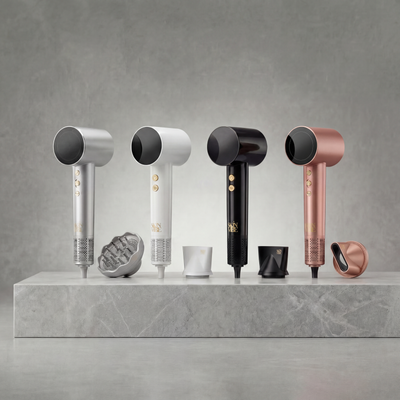
The SkinVibe Aurea Family x Plasma hair dryer combines everything I wrote about above: a 110,000 rpm brushless motor, plasma technology with one billion positive and negative ions per cubic centimeter, 7 modes, a maximum of 59 dB and a weight of 410 grams. We designed it from January 2024 as an answer to all the compromises I knew from years of testing hair dryers.

“When creating SkinVibe, I wanted to give you what I had always looked for myself: devices of the highest quality.” That’s what I said at the brand’s launch, and Aurea is the best proof of those words.
What makes it stand out in everyday use? Three things you won’t see in a spec table.
Modes that think for you. Aurea has 7 modes: constant temperature, alternating warm-cold, alternating hot-cold, long hair, short hair, child and pet. The long hair mode is a ready-made sequence: a minute of hot air, three minutes of alternating air, two minutes of warm air and a minute of cool air. You switch it on and dry, and the dryer takes care of temperature and setting by itself. A sensor checks the temperature a hundred times per second, and the memory function remembers your last setting.
Touch sensor. This is our little gem: Aurea switches itself off when you put it down and back on when you pick it up. It sounds like a fun fact until you remember how the airflow of a dryer that’s put down while still running scatters your cosmetics across the counter and can even push the dryer itself off the edge of the sink. You put it down and that’s it - you can section off the next strand in peace, reach for the coffee standing next to your cosmetics, get on with your routine. No blast of air, no mess.
Color LCD display. It shows the current mode, the temperature (a four-color ring: from blue for cool to red for hot) and the airflow level. No more guessing what you’ve just set.
On top of that: three magnetic nozzles with 360° rotation (both concentrators and the wavy diffuser), a magnetic air filter, an extra-long 2.7 m cord and a motor designed for 16 years of use at 10 minutes of drying a day. SkinVibe, with Aurea on board, received the title of Women’s Brand of the Year 2025 (Kobieca Marka Roku), awarded by a jury made up of women.

The video is in Polish. After you click, YouTube (Google) plays the video.
You’ll find the full specifications on the SkinVibe Aurea Family x Plasma hair dryer page. You have 30 days to return it without giving a reason and a 2-year warranty; that’s exactly what a top-shelf purchase should look like.
A sensible alternative: SkinVibe Libra AirLoom
Libra AirLoom is our second hair dryer: the same 110,000 rpm brushless motor, ionization with 200 million negative ions per cm³, three magnetic nozzles with 360° rotation and an LCD touch screen, at a more accessible price. For most hair, that set of features is more than enough.

Libra was created for people who want SkinVibe quality but don’t need Aurea’s full arsenal. Instead of plasma, there’s solid ionization that tames static and closes the cuticle. Instead of 7 modes: four temperature settings (cool air, 50, 70 and 90°C; use the highest one briefly and always in motion), three airflow speeds and a cool shot button. It dries short hair in 36 seconds and handles long hair in a few minutes. It weighs 420 g, just 10 g more than Aurea, and has the same extra-long 2.7 m cord.
You control it by touch, directly on the LCD screen, which shows the temperature and the airflow speed. There are two color options to choose from: black and white, both with gold details.

Aurea is simply a level up: plasma instead of ionization, quieter operation, special modes and the touch sensor. But if your hair isn’t the demanding kind and budget matters, Libra AirLoom will do its job beautifully, with no compromises on the things that really matter: motor, airflow and care.

The video is in Polish. After you click, YouTube (Google) plays the video.
Aurea or Libra? Comparison and my advice
Choosing between Aurea and Libra comes down to one question: how demanding is your hair? Frizzy, colored, hard to tame: go for Aurea with plasma and special modes. Normal, without much trouble: Libra will give you most of the effect on a smaller budget. I also compared all three of our hair dryers, including the little Nova, in a separate article, Aurea, Libra or Nova: which one to choose.
| Parameter | Aurea Family x Plasma | Libra AirLoom |
|---|---|---|
| Care technology | Plasma: 1 billion positive and negative ions per cm³ | Ionization: 200 million negative ions per cm³ |
| Motor | BLDC 110,000 rpm | BLDC 110,000 rpm |
| Airflow | 25.367 m/s | 22 m/s |
| Drying time (short hair) | 29 seconds | 36 seconds |
| Noise | max. 59 dB | max. 67 dB |
| Modes and temperatures | 7 modes (including child and pet modes) | 4 temperatures × 3 speeds + cool shot button |
| Nozzles | 3 magnetic, 360°, wavy diffuser | 3 magnetic, 360°, classic diffuser |
| Touch sensor (auto start/stop) | Yes | No |
| Display | Color LCD with temperature ring | LCD touch screen |
| Weight / cord | 410 g / 2.7 m | 420 g / 2.7 m |
| Returns and warranty | 30 days / 2 years | 30 days / 2 years |
My advice, without beating around the bush: if the dryer is for the whole family, if you color your hair or fight frizz, pay extra for Aurea. You’ll feel the difference in care from the very first drying. If you’re simply looking for a very good, fast and light hair dryer: Libra. You’ll find both in our hair dryer collection, and a detailed side-by-side of the specs on the comparison page. And if you’d rather have someone guide you through the choice, take my hair dryer quiz - you answer short questions about your hair and habits, and after 90 seconds you have a specific recommendation.
How to dry your hair without damaging it? Six rules and one myth
The best hair dryer won’t fix bad technique. Six rules of safe drying: blot your hair with a towel without rubbing, detangle it before drying, start at the roots, hold the dryer about 15 cm from your hair and keep it moving, direct the airflow down the cuticle, and finally set everything with 30-60 seconds of cool air.

First, a myth worth saying goodbye to: “air-drying is the healthiest way to dry your hair.” Sounds logical, right? Yet a study published in the Annals of Dermatology showed the opposite. Hair that dries naturally stays in contact with water for two hours or more, and soaking that long damages the inner structure of the hair more than proper blow-drying does. The researchers compared five drying variants, and drying from a distance of about 15 cm, in constant motion, came out best. The hair dryer isn’t your hair’s enemy. The enemy is a hot nozzle pressed against one strand.
And now the six rules, in the order I follow them myself:
- Blot, don’t rub. Press the towel against your hair instead of rubbing. A wet cuticle is open and vulnerable to mechanical damage.
- Detangle before drying. On tangled hair, the air works unevenly and you end up holding the dryer twice as long. At higher temperatures, it’s worth adding a heat protectant.
- Start at the roots. The scalp and roots take the longest to dry. Leave the ends, the oldest and weakest part of the hair, for last.
- About 15 cm and constant motion. This is exactly the variant that came out best in the research. Airflow held in one spot means local overheating that you won’t see right away, but your hair will remember.
- Concentrator down the cuticle, diffuser for curls. Air directed from roots to ends smooths; the diffuser’s spread-out air protects the curl pattern.
- Cool finish. 30-60 seconds of cool air closes the cuticle and sets your style for hours.
You’ll find a full guide with volume techniques and a list of the most common mistakes in our article on how to dry hair properly.
Anna’s summary
Choosing a hair dryer really comes down to six parameters and one decision. A brushless motor, sensible temperature control with cool air, operation below 70 dB, a weight as close to 400 g as possible, a full set of nozzles including a diffuser, and ionization or plasma if your hair frizzes and gets static. The decision? Match all of it to your own hair, not to the loudest ad.
The most common mistake is settling for a stopgap. A hair dryer bought carelessly will be a mediocre one every morning, for years. Choose a device that’s quiet, light and fast, and your mornings really do get simpler. I’m telling you this as someone who tested hair dryers professionally for twelve years and finally built her own.
If you have questions after reading this guide, write to us. We read every message and reply with specifics. 🤍
Anna Nowak-Ibisz, co-founder of SkinVibe
FAQ: the most common questions about choosing a hair dryer
Look for a hair dryer with a brushless motor, temperature control and cool air, running below 70 dB and as light as possible (the comfortable range is 400-650 g). So much for theory; in practice, the same doubts keep coming back when you buy. So I’ve gathered the questions I hear most often, about power, electricity use, noise and the difference between ionization and plasma, with short, specific answers.
What should you look for in a hair dryer?
Six parameters: the motor type (brushless BLDC instead of classic), ionization or plasma, temperature control with cool air, noise below 70 dB, a weight in the 400-650 g range and a full set of nozzles including a diffuser. Plus a match to your hair type: curly hair needs a diffuser, colored hair a low temperature.
Which hair dryer is the best?
The best hair dryer is the one matched to your hair, not the most expensive one on the shelf. For demanding, colored and frizzy hair, I recommend our Aurea Family x Plasma with plasma technology. For normal hair, a good brushless dryer with ionization, like Libra AirLoom, is more than enough.
How many watts should a good hair dryer have?
1500-1600 W is more than enough if the dryer has a fast brushless motor. Drying speed depends on the airflow (rpm and m/s), not on heater power. Our Aurea, at 1600 W, dries short hair in 29 seconds thanks to 110,000 revolutions per minute.
How much electricity does a hair dryer use?
A 1600 W hair dryer running for 6 minutes uses about 0.16 kWh, roughly as much as boiling one full kettle of water. Even with daily drying, the electricity cost adds only a little to your monthly bill.
What does ionization do in a hair dryer?
Ionization neutralizes the static charges that make hair frizzy and flyaway. Negative ions also help close the hair cuticle, so strands are smoother, shinier and easier to detangle. It’s a technology that really works, not a marketing gimmick.
How is plasma different from ionization?
Ionization emits negative ions and eliminates static in the hair. Plasma emits negative and positive ions at the same time, so it works more broadly: it protects the hair, improves its moisture, adds shine and affects the hair structure. Plasma is the premium technology; ionization is a very good standard.
Does blow-drying damage your hair?
Not if you dry it properly. A study in the Annals of Dermatology found that drying from about 15 cm away, in constant motion, damages hair less than air-drying, during which the hair stays soaked with water for over two hours. What harms hair is a hot airflow held close and in one spot.
How many decibels is a hair dryer, and how loud should it be?
Below 70 dB is a comfortable everyday level, and the quietest new-generation hair dryers run at 59-65 dB, the volume of an ordinary conversation. Classic designs can reach 80-90 dB. If you dry your hair early in the morning or near a child, this parameter matters a lot.