

How to curl your hair with a straightener: curls and waves
To curl hair with a straightener, clamp a 2-3 cm section a few centimeters from the roots, turn the straightener half a turn away from your face and glide down without stopping. Hold the curl in your hand until it cools. For waves, alternate directions; use the same temperature as for straightening.

My curling iron lives in a drawer. My straightener is always within reach. And for years, including my years on Pani Gadżet, a Polish TV show, I did my curls mostly with the latter, because one device can straighten, flip the ends and create waves, while a curling iron can do one thing. The problem is that most guides to curling with a straightener stop at “twist and pull”, and then you wonder why the curl looks like a kinked strand and falls apart after an hour.
That’s why I’ll write it the way I explain it to my friends at the mirror: what your hand does, what the temperature does and why a curl only sets once it cools. I founded the SkinVibe brand, so the examples will come from our straighteners, but the technique is universal: it will work with any straightener that meets the three conditions from the first section.
IN SHORT
- Curls with a straightener come down to three moves: you clamp the strand a few centimeters from the roots, turn the straightener half a turn away from your face and glide down smoothly without stopping. You take the curl off into your hand and wait for it to cool.
- Waves are the same moves in alternating directions, and “broken waves” are half a turn up, half a turn down, every few centimeters along the same strand.
- Curls hold thanks to cooling, not temperature. That’s why you set the same number of degrees as for straightening, and give more time to cooling than to heating.
- Dry hair, a heat protectant, sections of 2-3 cm, movement without stopping. Four rules that protect your hair and give you an even curl at the same time.
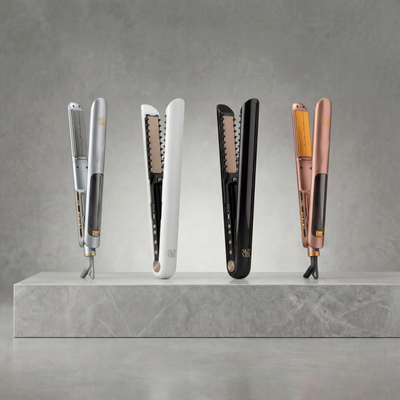
- Narrow plates and a rounded housing make curling easier. Our Astra does curls, waves and flipped ends; Luna, our cordless mini, flips the ends and creates gentle waves, but it won’t replace a full-size straightener.
Can you curl your hair with any straightener?
Almost any, but not all of them equally easily. For curls, three things count: a rounded housing (sharp edges leave kinks on the strand instead of arcs), plates about 2-3 cm wide (wide plates make big, loose waves, but you won’t make small curls with them) and temperature control with several settings, because a curl needs the same heat discipline as straightening. Floating plates, which adapt to the thickness of the strand, are a bonus: they don’t tug when you turn.
If your straightener has one “full blast” setting and an angular housing, the curls will come out, but they’ll have a visible crease, and more hair than you’d like will be left on the plates. Before you buy a new one just for curls, read my guide to choosing a hair straightener: the same criteria that protect your hair when straightening decide the quality of your curls.

Preparation: dry hair, heat protectant and temperature
Curls start before you switch on the straightener. Your hair has to be completely dry: trichologist Agnieszka Trepka says plainly in our podcast (in Polish) that styling with a straightener must be done on thoroughly dry hair, and working on damp hair is a mistake. With curls, it’s even more important than with straightening, because the strand stays on the plates longer. If you dry your hair right before styling, take a look at my guide to drying your hair properly.
Then a heat protectant, combed through the whole length. It isn’t a cosmetic extra: in a study published in the Journal of Cosmetic Science, straightening above 200°C changes the structure of keratin, and protecting your hair beforehand clearly reduces breakage. For curls, though, don’t use oil or a heavy serum before styling: a weighed-down strand won’t hold an arc, and oil on a hot plate gives off a smell you don’t want to know.
The temperature for curls is the same as for straightening your hair type. Not higher, because a curl’s staying power doesn’t come from heat, but from cooling. On Astra, we matched the five settings to hair types, and that’s a good starting point for any straightener with temperature control:
| Hair type | Temperature | Note for curls |
|---|---|---|
| delicate, bleached | 140°C | the curl comes out soft, give it longer to cool |
| normal, colored | 160°C | the most common everyday choice |
| curly | 180°C | to smooth natural curl into an even curl |
| thick, hard to style | 200°C | narrow sections, one move |
| very thick, exceptionally resistant | 220°C | an exception, only with a heat protectant and briefly |
The rule is simple: you start at the lowest setting at which the curl “takes” and don’t go higher without a reason. Online, you’ll find ranges for curls from 80 to 230°C, sometimes in a single guide, so instead of more ranges, I suggest a one-strand test: 160°C, curl into your hand, cooling, then check whether it holds. If it doesn’t, go one setting higher on the next strand; if it does, stay there. In the same conversation, Agnieszka Trepka repeats that settings above 210°C are too much for hair, unless you protect it with heat protection. The last preparation step is dividing your hair into sections 2-3 cm wide, held with clips. Thick sections are the most common reason a curl doesn’t work: the middle of the strand doesn’t get the heat and straightens in your hand after a minute.

The video is in Polish. After you click, YouTube (Google) plays the video.
How to curl your hair with a straightener step by step
A classic straightener curl is one turn and one move down. The whole art is to complete the half turn (180°, the strand should wrap around the housing) and to keep the movement smooth and without stops. Practice it first on a straightener that’s switched off: your hand should learn the gesture before the heat comes in.
- Take a section 2-3 cm wide and comb it through so it has no knots. Start with the lower sections at the back of your head; leave the top ones and those around your face for last.
- Close the straightener a few centimeters from the roots, not right at the scalp. Hold the plates at a slight angle to the strand, not perfectly horizontal.
- Turn the straightener half a turn away from your face, so the strand wraps around the housing. The “away from the face” direction opens up your features; save the opposite direction for the back of your head if you want to mix directions.
- Glide down smoothly, pulling the strand gently with your other hand. The pace: slower than when straightening, but without stopping in one place. A stop means local overheating and a visible kink in the curl.
- Take the curl off into your hand and hold it for a dozen or so seconds before you let go. This is where the most important thing happens: hair takes on a shape while it’s warm and sets it while it cools. A curl released while hot will straighten out under its own weight.
- Don’t comb it out straight away. Once your whole head has cooled, separate the curls with your fingers, not a brush. A brush turns curls into fluff, while fingers turn them into waves.
- Set lightly: a mist of hairspray or a salt spray from a distance, not up close. Heavy hairspray glues the curl together, and a glued curl looks like it’s from twenty years ago.

The first curl usually comes out too weak or with a crease. That’s normal: the technique lives in your wrist and needs a few strands to get into a rhythm. Don’t fix the same strand three times; it’s better to do the next ones and come back to the weaker ones at the end, once the rest have cooled.
The shape of a curl is geometry, not chance. Half a turn (180°) gives a loose curl or a wave, a full turn (360°) a more defined, tighter curl. A straightener held vertically makes a spiral, while one held almost horizontally gives a soft wave. There’s no single “correct” angle; there’s the one that gives you the curl you want, and you stick to that angle all over your head, because mixed angles look like a mistake, not a hairstyle.
How to make waves with a straightener
Waves are curls that disagree about direction. You take slightly wider sections (3-4 cm) and turn the straightener half a turn as you would for a curl, but you curl every other section in the opposite direction: one away from your face, the next towards it. When you separate them with your fingers after cooling, curls going in different directions don’t form a single roll, but a soft, irregular wave.
Two tricks for a “beachy” effect: start the turn lower, roughly at ear level, so the roots stay flat, and leave the last 2-3 cm of the ends outside the plates, straight. A wave with straight ends looks natural, while a wave curled right to the end looks like a prom hairstyle. If you want gentle waves that are barely visible, take even wider sections and turn the straightener only a quarter turn.

Broken waves with a straightener: half a turn up, half a turn down
“Broken waves” (some of you call them “bent curls”) are waves with clear, slightly angular bends, like after undoing a braid, only more even. You make them on a single strand by changing direction as you move: you close the straightener a few centimeters from the roots, turn it half a turn up and pull it a few centimeters, then turn it half a turn down and pull it a few centimeters again, and so on to the end of the strand. Each change of direction is one bend in the wave.
Two things are key: equal segments (the same distance between changes of direction on all strands, otherwise the waves don’t “rhyme” with each other) and movement without stopping at the point where you change direction. If you pause as you turn, instead of a bend in the wave you’ll get a pressed-in mark from the plate. With this technique, set the temperature as for straightening and take narrow sections, because the straightener works on each segment half as long as with a regular curl.
Flipped ends: the simplest straightener style
If curls are too much for you and straight hair too little, there’s a middle ground: a straightened strand with a flipped end. You guide the straightener as when straightening, and over the last 5-8 cm you turn your wrist inward (towards your neck) and go all the way to the end of the strand. Ends flipped outward are done with the same move in the other direction. This is exactly the style we call “turned under” on our Astra: two minutes more than straightening, and your hair looks done.
Straightener curls on short, medium-length and long hair
Short hair and bobs. This is where the most questions and the most disappointments are, because a short strand has nowhere to wrap. What works: narrow plates, small sections (2 cm), the straightener closed near the roots (but not at the scalp) and a short, quick move with a full turn (360°), so the short strand has time to wrap. On a bob, curls turned away from the face with straight ends, or simply ends turned under, look nicest. A mini straightener has the advantage at this length: shorter plates are easier to turn on a short strand. Our Luna MiniWireless is 22 cm long and has a comb next to the plates that guides the strand; on a bob and bangs, it creates flips and gentle waves in a few moves. You’ll find how to straighten short hair so your style lasts all day in my guide on how to use a mini straightener for short hair.
Medium-length, shoulder-length hair. The most rewarding length: there’s room to wrap the strand, and the curl isn’t weighed down. Half a turn, a smooth glide down, alternating waves. If your curls drop by the evening, the culprit is usually a section that’s too big or a curl released too early, while still warm.
Long hair. A long, heavy curl stretches under its own weight, so take narrower sections than seems necessary, curl from the ear down (flat roots), and take each curl off into your hand and hold it until it cools, ideally coiled and pinned with a clip for a few minutes. With very long hair, a full-size straightener with long plates that take a wider section at once saves time; mini devices are only for touch-ups here.
Why don’t your straightener curls work? Symptom, cause, fix
Most “it doesn’t work for me” cases come down to one of five recurring mistakes, and each has a simple fix. Look for your symptom in the left column.
| Symptom | Most common cause | Fix |
|---|---|---|
| the curl drops after half an hour | released while still warm, too thick a section or oil before styling | curl into your hand or a clip until it cools, sections of 2-3 cm, heat protectant instead of oil |
| kinks and creases instead of arcs | stopping during the turn, an angular housing, pressing too hard | continuous movement, lighter pressure, a straightener with a rounded housing |
| curled at the top, straight at the ends | the strand slipped out of the plates before the end or was released too early | go all the way to the end of the strand, take the end off into your hand together with the curl |
| the curl looks dull, the hair “rustles” | the temperature is too high or the strand is damp | one setting lower, only dry hair, heat protectant along the whole length |
| the curls come out, but after combing you’re left with fluff | a brush on warm curls | fingers after cooling; a soft-bristle brush only for Hollywood waves |
How do you make straightener curls last?
A curl falls apart for three reasons: it was released while hot, it was made on too thick a section, or the hair was weighed down by oil or a leave-in conditioner. So the rescue order looks like this: hair washed and fully dried (a slightly “rough” strand holds better than a slippery one), a heat protectant instead of oil, sections of 2-3 cm, each curl into your hand or a clip until it cools, separating with your fingers only once cold, and a mist of setting spray from a distance.
One observation from my own practice: curls done on the second day after washing last longer for me than on freshly washed hair, because the strand has more grip. And if your hair is naturally heavy and straight, don’t fight for spiral curls; do alternating waves, which look good even when they partly drop.
Six mistakes that ruin curls and damage hair
I’ve seen each of them hundreds of times, and each can be eliminated in one evening.
- Damp hair. The curl won’t work, and the hair will suffer: in a study on how water affects heat damage to hair, a straightener on wetted strands caused much greater structural damage than on dry ones.
- Too high a temperature “so it holds”. A curl holds thanks to cooling. There’s no point going higher than for straightening.
- Stopping the plates in one place. A plate mark on the curl and local overheating. The movement should be slow but continuous; for our Luna, the manual says it plainly: a maximum of 10 seconds in one place.
- Squeezing too hard. The strand should turn around the housing, not be crushed. Too much pressure creates creases and tugs during the turn.
- A brush instead of fingers. Combing out warm curls with a brush is the fastest way to ruin an hour of work.
- No heat protectant, because “it’s only the ends”. With curls, the plates work along the whole length of the strand and for longer than with straightening.
Astra and Luna for curls: which one for whom?
I’ll tell you straight how it is with our straighteners. Astra SteamPlasma is a full-size straightener (30 cm, 376 g without the cord) with smooth-gliding ceramic plates, five temperature settings from 140 to 220°C and a 28-second heat-up, and besides straightening, it does ends turned under, gentle curls and waves. It has steam, but for curls you can switch it off with one button; the curling technique is identical with and without steam, and I wrote about what steam brings to straightening in a separate article on the steam straightener. Who is it for? For those of you who style regularly and want to straighten, curl and flip with one device without switching tools. If, after curling, your ends are already rough and lighter, take a look at my article on heat-damaged hair: how to recognize it and what can still be done.

Luna MiniWireless is the other end of the scale: 22 cm, 220 g, cordless, three temperatures (165, 185 and 210°C), floating ceramic plates with a comb and 50 minutes of use on one charge. It flips the ends and creates gentle waves (you hold the end wrapped around the plates for about 7 seconds), but it won’t give you spiral curls along the whole length like a full-size straightener, and we don’t pretend otherwise. Who is it for? For those who flip their bangs and ends on the go, or touch up their waves after a workout or while traveling. I wrote honestly about where convenience ends and compromise begins in my article on cordless straighteners. If you’re torn between the two, the hair tool quiz has a path for straighteners, and you’ll see both in our straighteners collection.
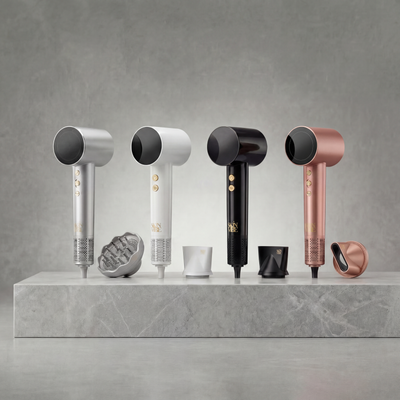
And if you prefer to curl without a plate that has its own heating element, a hot air styler will also do curls and waves: it wraps a damp strand with a stream of heated air and dries it at the same time. The curl is softer than with a straightener, but you dry and curl with one device. I’ve described how to do it in my article on how to curl hair with a hot air styler, and our Nuvia AirPlasma has two Curling Barrels for this, 32 and 40 mm, with a rotating tip for two curl directions and air of up to 90°C.
Frequently asked questions about straightener curls
Can you curl your hair with a straightener?
Yes, and for many of you it’s more convenient than a curling iron, because one device straightens, flips the ends and creates curls or waves. It’s easiest to curl with a straightener that has a rounded housing and plates 2-3 cm wide; wide, angular models leave kinks in the curl.
What temperature should you use for straightener curls?
The same as for straightening your hair type: usually 160-180°C, for fine and bleached hair 140-160°C, for very thick hair 200°C. A higher temperature doesn’t improve how long the curl lasts; letting the strand cool before you release it does. Above 210°C is too much for hair, unless you use a heat protectant, and only with exceptionally resistant hair.
How do you curl your hair with a straightener so the curls last?
The most important part happens after you take the strand off the plates: the curl in your hand or in a clip until it’s completely cool, separating with your fingers once cold and a mist of setting spray from a distance. You have the full list (dry hair without oil, heat protectant, sections of 2-3 cm, a completed half turn) in the section above; for me, curls on second-day hair last longer.
Can you curl short hair with a straightener?
Yes, although these will be flips and waves rather than spirals. Take small sections, close the straightener near the roots and do a quick full turn (360°) with a short glide down. A mini straightener with short plates is more convenient on a bob than a full-size one.
Can you curl wet hair with a straightener?
No. Your hair must be completely dry, because moisture under hot plates evaporates violently and damages the hair’s structure from the inside, and the curl won’t set anyway. First the hair dryer, then a heat protectant, and only then the straightener.
Which way should you curl your hair with a straightener?
For curls, most often away from your face, because that direction opens up your features; for waves, alternately, every other section in the opposite direction. More important than the direction itself is consistency at the front, around your face; at the back, you can curl however you like, because nobody’s going to count anyway.
Why won’t my straightener curls work?
The three most common reasons: a curl released before it cooled (it drops within half an hour), too thick a section (the middle doesn’t get the heat), and stopping or pressing too hard during the turn (creases instead of arcs). You’ll find the full list of symptoms with fixes in the table above.
How do you do Hollywood waves with a straightener?
Curl all sections in the same direction (away from your face), take wider sections (3-4 cm), coil each curl in your fingers and pin it with a clip for a few minutes, and after cooling, brush everything through with a soft-bristle brush so the curls join into one smooth wave. Set with hairspray from a distance. This is the only case where a brush after curling is appropriate. I show the curling iron version, with the curls cooling in clips, in my guide on how to do Hollywood waves with a curling iron.
Can you curl your hair with a steam straightener?
Yes. The technique is the same as with a classic straightener; on our Astra, you can switch the steam off with a button or leave it on, since the curl depends on the movement and the cooling, not on the steam. You’ll find more about what steam brings to straightening in my article on the steam straightener.
Finally, one sentence that’s enough to remember: a curl is made in your hand, not on the plates. Heat gives it shape, cooling sets it, and everything else is wrist practice. Give yourself three evenings, and you’ll see the difference.
Anna Nowak-Ibisz, co-founder of SkinVibe