

Hair dryer brush or hot air styler? How to blow-dry with a brush
A hair dryer brush dries and styles with one brush, while a hot air styler also has curling barrels and a diffuser. I show when a brush is enough, how a round brush differs from an oval one and how to dry your hair with it step by step, including short hair and bangs.

Hair dryer brush, hot air brush, hot air styler, multistyler: in stores, these names sit side by side, but behind them are two different devices. The first is a brush that blows warm air, the second is a hair dryer with several attachments, including curling barrels. Before you choose, it’s worth knowing what result you want in front of the mirror in the morning, because a brush is enough for volume and smooth lengths, but not for curls.
For twelve years on “Pani Gadżet”, my own show on Polish TV, I tested a great many hair dryers. For a long time, you’ve been writing to us that our range was missing a brush, so in the Nuvia AirPlasma hot air styler, we gave you two at once: a round one and an oval one. Below, I describe the differences between these devices and show you how to dry your hair with each of these brushes.
IN SHORT
- A brush dries and styles, but curls need a curling barrel. A hair dryer brush gives you volume, smooth lengths and curled ends, but you’ll only create curls and waves with a curling barrel, for example on a hot air styler with attachments.
- Round or oval? A round brush lifts hair at the roots and curls the ends, for short and shoulder-length hair. An oval brush smooths and dries larger sections in one pass, for long, thick and frizzy hair.
- You use a brush on damp, not wet hair. First pre-dry it with a towel and the nozzle, then dry it section by section from the nape of your neck and set each one with cold air.
- Warm air, no more than about 70°C. Polish dermatologist Marcin Zakrzewski recommends air of no more than about 70°C, so for the brush, choose the warm mode, not the hot one.
Hair dryer brush, hot air brush and hot air styler: what’s what?
A hair dryer brush and a hot air brush are two names for the same device: a brush that blows warm air. In stores, you’ll also find it as a blow dry brush or a brush dryer, and the version with a spinning brush as a rotating brush or a rotating hot air styler, hence all the confusion. A hot air styler, also called an air styler or a multistyler, is a hair dryer with several interchangeable attachments, which sometimes include brushes.
Hair dryer brushes are either rotating or static. In a rotating one, the brush spins by itself and you guide it along the strand. In a static one, the brush stays still and your hand does the movement, just like when you style with a round brush and a regular hair dryer. Both dry and style, but neither will create a defined curl, because for that you need a barrel: a classic curling iron with a heating element or an air curling barrel.
I describe how an air curling barrel works and what to look for when buying one in my guide to what a hot air styler is and how to choose one.
Hair dryer brush or hot air styler: when is a brush enough?
A brush is enough if, day to day, you want volume at the roots, smooth lengths and curled ends. If you also want curls, waves or to dry your natural curl pattern without frizz, you need a curling barrel or a diffuser: separate devices or one with several attachments.
| Result | Brush alone? | What to use |
|---|---|---|
| Volume at the roots | yes | round brush |
| Smooth lengths, less frizz | yes | oval brush |
| Curled ends | yes | round brush |
| Soft, loose waves | not really | a larger-diameter curling barrel (a rotating brush will give you a loose wave at most) |
| Bouncy curls | no | a smaller-diameter curling barrel |
| Natural curls without frizz | no | diffuser |
In practice: if you dry your hair every day and curl it only now and then, a brush will handle most mornings. If you do waves every week, it’s more convenient to have one device onto which you fit both a brush and a curling barrel. I show how to turn curls into one smooth wave for the evening in my article on Hollywood waves step by step. You dry a natural curl pattern with a diffuser, which I write about in my article on the hair dryer with a diffuser.

Round or oval brush: what result does each one give?
A round brush lifts hair at the roots and curls the ends, so it works best on short and shoulder-length hair. An oval brush is wider and flatter: it smooths and dries larger sections in one pass, which is why it suits long, thick or frizzy hair better.
A round brush wraps all the way around the strand, so it’s easy to turn the ends under or flick them out and lift the hair away from the scalp. An oval brush has a larger surface on which the strand lies flat, so the warm air smooths it across its whole width.
In your messages to us, the request for a “thick brush” for the hair dryer keeps coming up. Before you decide which one it should be, answer one question for yourself: do you want more volume or more smoothness? For shoulder-length hair that goes flat around the face, choose the round one. For long, thick hair that frizzes after every wash, the oval one.
How do you dry your hair with a hair dryer brush, step by step?
Drying with a hair dryer brush takes five steps: heat protection, pre-drying until your hair is damp, dividing it into sections, guiding the brush from roots to ends and setting each strand with cold air. Dermatologist Marcin Zakrzewski describes styling with a round brush and a regular hair dryer in a similar way in his guide (in Polish): sections starting from the nape, air directed onto the wrapped strand and cool air at the end. With a hair dryer brush, you hold the brush and the airflow in one hand.
1. Apply a heat protectant
Apply a heat protectant to washed, towel-dried hair. According to a review of hair cosmetics in the International Journal of Trichology, styling with a hair dryer or a straightener calls for a product with silicones, which spreads heat across the surface of the hair, so the water inside it doesn’t boil.
2. Pre-dry your hair until it’s damp
Wet hair is dark and heavy, and water drips from it. Damp hair is cool to the touch, but it no longer drips and starts to separate into strands. You only start using the brush once your hair is damp, and you get there with a towel and the drying nozzle.

In practice: the less water is left in your hair, the less time you hold the brush with your arm raised. It’s also not worth leaving hair wet for a long time. In a 2011 study by Lee and colleagues, hair left to dry naturally had a damaged layer that holds the hair’s cells together, while a hair dryer kept moving at a distance of 15 cm harmed it less.
3. Divide your hair into sections
Clip up the top and start with the strands at the nape of your neck. Take strands no wider than the brush. Warm air will only dry a wider strand on the surface, and it will stay damp inside.
4. Guide the brush from roots to ends
Slide the brush under the strand right at the roots, hold it there for a moment and slowly guide it down to the ends. Set a medium speed and warm air: according to dermatologist Marcin Zakrzewski, too strong an airflow can tangle hair, and the recommended temperature is no more than about 70°C. Go over each strand several times until it’s dry.
5. Set the strand with cold air
When the strand is dry and the brush is still in it, switch on cold air for a few seconds. A cool blast at the end closes the hair cuticle and gives it smoothness and shine, as the dermatologist writes in his guide. Only then slide the brush out.
I write more about drying itself, without a brush, in my guide on how to dry your hair properly.
Volume at the roots and curled ends: the round brush
You create volume at the roots with a round brush: slide it under the strand at the scalp and lift it upward. You get curled ends when you wrap the ends of the strand around the brush and set them with cold air. It works the same way with or without bangs.

On the crown, lift the strands straight up, and around the face slightly back, so they lift away from the forehead. At the ends, decide on the direction: ends turned under give a smooth line, flicked out a lighter, more casual look. With fine hair that quickly goes flat, set each strand at the roots with cold air before you slide the brush out.
In a short video, a creator shows the set of our Nuvia and then styles her shoulder-length hair with bangs: she lifts it at the roots with the Oval Brush and the Round Brush, and creates soft waves with a curling barrel.

After you click, YouTube (Google) plays the video.
Smooth hair without a straightener: the oval brush
An oval brush will smooth straight and slightly wavy hair while you dry it, so on an ordinary morning, you don’t need a straightener. You’ll gain the most from it with thick hair, because its wide surface smooths a bigger part of the strand at once.

According to a paper on shampoo pH in the International Journal of Trichology, the main cause of frizz is friction. That’s why you should guide the oval brush smoothly, in one movement from roots to ends, without tugging and without brushing an already dry strand over and over. I write about why hair gets static and what helps in my article on static hair.
A brush won’t straighten very tightly curled hair the way a straightener does. It will smooth it, but it will take more time. If you straighten very curly hair every day, you’ll still need a straightener.
A hair dryer brush on short hair and bangs
A hair dryer brush also works on short hair, because with a round brush, you can turn the ends under and lift the hair at the roots. An air curling barrel needs a strand long enough to wrap around it, so with a bob, the brush is what you’re left with. On our Nuvia, the brushes work from chin length, while the Curling Barrels need a strand that wraps around the barrel at least twice, meaning hair past the shoulders.
Bangs dry the fastest, so start with them while they’re still damp. Choose the lowest airflow speed, because a strong stream blows short strands around. In your reviews, you tell us the airflow is too strong, bangs included. Guide the brush from top to bottom and, at the end, turn your bangs slightly under.
With short hair, work with smaller strands and hold the brush in one place for less time, because a short strand dries in moments.
The most common mistakes when drying with a brush
If a brush-styled look drops quickly or your hair tangles, check whether you’re making one of these mistakes. You can fix each of them the next time you dry your hair.
- Hair that’s too wet. The strand takes a long time to dry, your arm gets tired and the brush drags heavy, wet hair. That’s why you should first squeeze it out with a towel and pre-dry it with the nozzle.
- Strands that are too thick. The strand is dry on the surface but stays damp inside, so the style drops quickly.
- Twisting the brush in place. Twisting the brush at the roots instead of guiding it down tangles the strands. With a rotating brush, long, fine hair can get wound into it.
- Too hot and too strong for fine hair. Dry fine and bleached hair with warm air at a lower speed.
- No cold-air finish. A warm strand easily loses its shape, so without cold air, the volume disappears on your way to work.
- Holding the brush in one place. The brush should be moving all the time, and the airflow mustn’t heat the same section of hair for long.
The brushes on our Nuvia AirPlasma
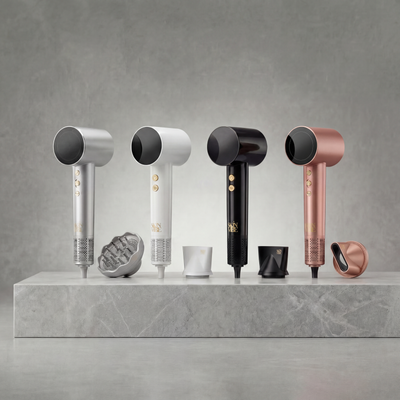
We equipped Nuvia AirPlasma, our hot air styler, with seven attachments on one body: the Drying Nozzle, Concentrator, Diffuser, two Curling Barrels (32 mm and 40 mm), the Round Brush and the Oval Brush. The brushes click onto the body, and both are static: you guide the strand by hand, as with a classic blow-dry. It’s the Curling Barrels that have a rotating tip, and turning it changes the direction of the airflow.
The Round Brush is the one for volume and curled ends, like a blow-dry at the hair salon. The Oval Brush also has bristles between its pins, and it’s the one you’ll use to smooth long strands. You pre-dry your hair with the Drying Nozzle. Nuvia has four air modes: cold 30°C, warm 70°C, hot 90°C and a hot-cold cycle, plus three airflow speeds. For the brushes, choose the warm mode, because it’s within the dermatologist’s recommendation. To set a strand, you hold the temperature button: after about 1.5 seconds, cold air comes out and keeps flowing for as long as you hold it, and when you let go, Nuvia returns to the previous mode.

Inside, there’s a BLDC (brushless) motor running at 110,000 revolutions per minute with airflow of up to 24 meters per second (m/s), so with the Drying Nozzle, you’ll quickly pre-dry your hair before you fit the brush. Plasma technology (emitting negative and positive ions at the same time) delivers 400 million ions per cubic centimeter (cm³), so your hair frizzes less.
Nuvia weighs 477 g with the cable, without attachments. That’s why, with long hair, you should first pre-dry it with the nozzle and fit the brush only for styling: your arm is then raised for less time. The cable is 2.7 m long, so you can stand at the mirror even if the outlet is farther away. You dry bangs on the lowest of the three speeds, and after you switch it off, Nuvia remembers your last settings. In practice: in the morning, you fit the brush and start drying straight away in your mode, without setting everything up from scratch.
Nuvia is a good fit when you want to dry, style with a brush and curl your hair from time to time with one device. Its Curling Barrels, however, need hair past the shoulders. If you don’t curl your hair at all, the comparison of a hot air styler and a hair dryer, using Nuvia and Aurea as examples, will help you decide. If you’re not sure which device suits your hair, take our hair tool quiz.
You can try the brushes of the Nuvia AirPlasma hot air styler on your own hair at home: you have 30 days to test it from receiving the parcel.
Frequently asked questions about hair dryer brushes
Is a hair dryer brush any good?
Yes, if you want to dry and style with one device, without holding a brush in one hand and a hair dryer in the other. For curls and defined waves, however, you need a curling iron or barrel.
How do you blow-dry hair with a brush?
Blow-drying hair with a brush takes five steps: apply a heat protectant, pre-dry your hair until it’s damp and divide it into sections, starting from the nape. Slide the brush under the strand at the roots and slowly guide it to the ends at medium speed with warm air. Set each dry strand with cold air.
Which brush is good for blow-drying hair?
One that suits the result you want and the length of your hair. For volume at the roots and curled ends on short and shoulder-length hair, choose a round brush, and to smooth long, thick and frizzy hair, an oval brush, which takes a wider strand at once. With a hair dryer brush, also check whether it has cold air to set the strand and a low speed for bangs.
What’s the difference between a hair dryer brush and a hot air styler?
A hair dryer brush usually has one brush that you dry and style with. A hot air styler has several interchangeable attachments, for example a drying nozzle, air curling barrels and brushes, and sometimes a diffuser. With a brush, you’ll create volume and smooth lengths, and with a curling barrel, also curls and waves. I describe how air curling barrels work and how to use them in my guide on how to use a hot air styler.
Does a hair dryer brush damage hair?
It can, if you dry with air that’s too hot, hold the brush in one place or tug at wet strands. Dermatologist Marcin Zakrzewski recommends air of no more than about 70°C and a heat protectant before drying. With this setting, a brush that keeps moving and a cold-air finish, daily styling puts less strain on your hair.
Rotating or static hair dryer brush?
A rotating one spins the brush by itself, so it’s easier to turn the ends under, but with long, fine hair, the strand can get wound into it. You guide a static one by hand: it takes a little practice, but you’re in control of the direction of movement and the tension of the strand.
Can a hair dryer brush replace a hair dryer?
With short hair, it can be enough, because the brush dries by itself and short strands dry quickly. With long, thick hair, drying your whole head with just a brush takes a long time and tires your arm, which is why you first pre-dry it with a hair dryer or a drying nozzle and fit the brush only for styling. So a hot air styler with a separate drying nozzle can replace a hair dryer. On our Nuvia, that’s what the Drying Nozzle is for.
Hair dryer brush on wet or dry hair?
On damp hair. With wet, dripping hair, first squeeze out the water with a towel and pre-dry it with the nozzle until it stops dripping. On completely dry hair, a brush won’t change much, because hair takes its shape as it dries.
Which hair dryer brush is best for short hair?
For short hair, choose a round brush that a short strand can wrap around, and a device with a low airflow speed for bangs. A round brush will turn the ends under and lift the hair at the roots, even with short strands. On our Nuvia, the Round Brush works from chin length.
Your first time drying with a brush takes longer, because you’re only just learning the angle and the pace. After a few goes, the movement becomes second nature and you do all your styling with one hand. Choose the result first, and only then the brush.
Anna Nowak-Ibisz, co-founder of SkinVibe