

Static hair: why it happens and how to dry your hair to stop it
Hair gets static because it’s an insulator: friction against hats, scarves or plastic brushes charges it, and dry winter air keeps the charge on. Dry it with lukewarm air from about 15 cm, along the cuticle, with ionization or plasma and a cool finish, and wear a cotton or wool hat.

You take off your hat and your hair stands on end, sticks to your cheeks, crackles under the brush, and every attempt to smooth it down makes things worse. Static hair is a winter classic and one of the questions I get most often from November to March. As a co-founder of SkinVibe, I look at it from two sides: the physics of hair and what can be done in a hair dryer so that the charge doesn’t build up.
Below I explain why hair gets static and why winter is the worst, how static differs from frizz, how to dry your hair so it doesn’t get static, what ionization in a hair dryer really does, and which hats, brushes and pillowcases help and which make it worse. Then there’s quick help for when your hair is “flying away” at work, and at the end, the questions that come up most often.
IN SHORT
- Hair gets static because it’s an insulator: when it rubs against a hat, a scarf, a plastic brush or a pillow, it gives up electrons and becomes positively charged, and like charges repel each other. Hence hair “standing on end”.
- Winter is the worst because the air in heated rooms is dry: the thin layer of moisture that normally carries the charge away from the hair disappears. Dry hair plus dry air plus synthetic fabrics: that’s the perfect recipe for static.
- Static isn’t frizz: frizz is a cuticle opened by moisture, static is a charge on dry hair. They’re treated in a similar way (moisture, a closed cuticle), but the cause is the opposite.
- How to dry: with lukewarm air, from a distance of about 15 cm, along the cuticle, with ionization or plasma, and finish with cool air. Don’t over-dry: dry hair gets charged most easily.
- Outside the bathroom: a cotton or wool hat, ideally with a silk lining, instead of acrylic, a natural-bristle or wooden brush instead of plastic, a little cream or oil on the ends, and in an emergency a damp hand run over your hair.
Why does hair get static?
Hair gets static because keratin, which it’s made of, is an insulator: when you rub it against another material, such as a hat, a scarf, a plastic brush or a pillowcase, the hair gives up electrons and becomes positively charged. Charges of the same sign repel each other, so strands move away from each other and from the head; hence the floating, “flyaway” hair and the crackling when you comb.
This phenomenon is called charging by friction, and it applies to all insulators; physics textbooks illustrate it with a comb rubbed against hair “on a dry day”. Studies using atomic force microscopy have shown that the charge on the surface of hair builds up precisely through contact with materials such as plastic combs or latex, and that it largely determines how hair lies and how “manageable” it is (Lodge and Bhushan, 2007). The stronger the friction, the more charge, and damaged hair charges differently from healthy hair and differently from hair protected with conditioner (Seshadri and Bhushan, 2008). In practice this means two things: the material your hair rubs against matters, and so does the condition of the hair itself.
If the charge always builds up, why does hair behave normally in summer? Because it usually has a way to escape. There’s a thin film of moisture on the surface of the hair, and the humid air around it carries the charge away before it has time to accumulate. And this is where winter comes in.
Why does hair get the most static in winter?
Hair gets the most static in winter because the air in heated rooms is very dry, so the charge has no way to drain off the hair, and on top of that there’s a synthetic hat, a scarf, a jacket hood and hair dried out by frost and radiators. Each of these factors causes static on its own; together they create that famous “cloud” after you take off your hat.
Dry air is the key. A review published in 2024 in the Biomedical Journal describes how at low relative humidity, typical of winter and heated interiors, electrostatic charges build up on people and objects much more easily, because the moisture that normally dissipates them is missing; the comfortable range is about 40-60% humidity, and in an apartment in winter it is often much lower. That’s why a humidifier in the bedroom or a wet towel on the radiator does more for your hair than many a conditioner.
The second factor is the material. Acrylic, polyester and fleece, which most hats are made of, get especially static in contact with hair; wool less so, cotton and silk the least. The third is the condition of your hair: dried out by radiators and frost, with an open cuticle, it charges more easily and holds the charge longer. Winter simply brings these three things together.
Static hair or frizz: how to tell them apart?
Static is a charge on dry hair in dry air: strands lift, repel each other and stick to your face, especially in winter; frizz is a cuticle opened by moisture: hair swells, loses its shape and “grows” in the rain or in a steamy bathroom. The causes are opposite (too dry versus too wet), but both problems share the same weakness: an open cuticle and a poor moisture balance in the hair.
That’s why some of the advice overlaps: a closed cuticle, well-moisturized hair and drying downward along the cuticle help with both. The difference lies in the season and in what your hair is missing. In winter it lacks moisture inside (moisturizing, less heat, less friction); in summer excess moisture from outside ruins the style (closing the cuticle, light products). I wrote about frizz and how to dry your hair so it doesn’t frizz in my guide on how to dry hair properly.
What is static hair missing?
Hair that gets static is usually missing moisture inside and a smooth, closed cuticle outside; the more dried out and porous it is, the more easily it charges through friction and the longer it holds the charge. It isn’t missing a miracle ingredient from an ad; it’s missing water and protection from friction. I’ve described how to recognize high porosity hair and how to dry it in my guide on hair porosity.
Hair in good condition has a cuticle that lies flat like roof tiles; such hair glides over a hat and over other hairs, so friction is low. Hair that is dried out, bleached or often straightened has a raised cuticle: it catches on everything, friction goes up, and so does the charge. On top of that, dry hair has no film of moisture on its surface that could carry the charge away. That’s why winter care for static hair is above all about moisture (masks, leave-in conditioners on the ends, hair oiling) and less heat when styling.
How to dry your hair so it doesn’t get static?
Dry with lukewarm, not hot, air, from a distance of about 15 cm, directing the airflow from roots to ends, that is, along the cuticle; use a hair dryer with ionization or plasma if you have one, finish with cool air and don’t dry your hair “bone dry”. Over-dried hair is hair that will get static the first time it touches a hat.
Step by step. Temperature: hot air evaporates more water from the hair than necessary and opens the cuticle, so in winter go one setting lower; in our podcast (in Polish), trichologist Agnieszka Trepka talks about a maximum of 90°C and an ideal of about 70°C. Distance and movement: a study published in the Annals of Dermatology showed that a hair dryer held 15 cm from the hair and kept constantly moving damages it less than air-drying, while from 5 cm it already damages it. Direction: a concentrator moved from top to bottom lays the cuticle flat, and a flat cuticle gets less static. Cool air at the end closes the cuticle and sets the style. And the last, most often skipped step: dry to about 90% and leave the rest, instead of finishing off with heat to zero; that little bit of moisture inside the hair is your natural anti-static.

What does ionization in a hair dryer do for static hair?
Ionization in a hair dryer sends negative ions into the airflow, and they neutralize the positive charge that builds up on hair during drying, so strands don’t repel each other, the cuticle lies flat and hair comes out from under the dryer smoother and calmer. It’s the simplest and most direct way a device can deal with static, because it acts on the cause, that is, on the charge itself.

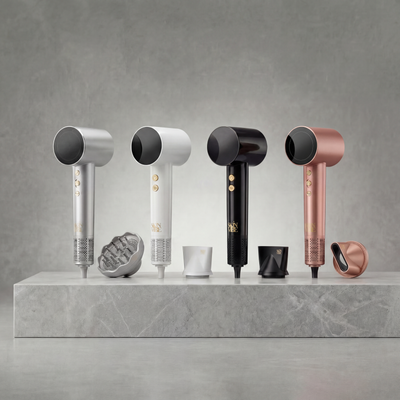
In our Libra AirLoom, ionization means 200 million negative ions per cm³; in Aurea Family x Plasma, plasma fills the air with one billion positive and negative ions per cubic centimeter; and in the small Nova PlasmaGo the same technology delivers the same dose, half positive and half negative; all of them balance the charges on the surface of the hair during drying. I’ve described what ionization does in a hair dryer and how it differs from plasma separately in my article on plasma technology, and how to choose a hair dryer with ionization and how to tell whether it really has it, in my guide hair dryer with ionization: how to choose.
To be honest about the limits: ionization works while the dryer is running. It neutralizes the charge that builds up during drying and leaves hair with a closed cuticle, so it gets less static later on, but it won’t make it immune to an acrylic hat at four in the afternoon. If your hair is still “flying away” after you leave the house, the problem lies in the hat, the brush or over-drying, and that’s where to look.
Which hat, scarf and pillowcase won’t make your hair static?
Silk, satin, cotton and, to a lesser extent, wool cause the least static, meaning fabrics that are smooth or natural; acrylic, polyester, fleece and nylon cause the most, which unfortunately means most winter hats and hood linings. If you have one thing to change this season, swap your hat for a cotton or wool one with a silk or satin lining.
| Item | Causes static | Better choice |
|---|---|---|
| Hat, scarf, hood | acrylic, polyester, fleece, nylon | cotton, wool; ideally with a silk or satin lining |
| Brush and comb | plastic, nylon pins | natural bristles (e.g. boar), wood; wide wooden teeth for curls |
| Pillowcase | polyester, microfiber, blends | silk or satin, or smooth cotton |
| Clothes close to your hair | acrylic turtlenecks and sweaters, fleece collars | cotton, merino wool, silk |
| Air at home | heating without humidifying | a humidifier or a wet towel on the radiator, especially in the bedroom |
A little trick for a hat you don’t want to replace: before putting it on, run a hand with a bit of hand cream or a drop of oil over your hair, and put the hat on completely dry hair; damp hair dries under it squashed and with an open cuticle, and then gets even more static.
Which brush should you use for static hair?
A natural-bristle or wooden brush with widely spaced teeth, and preferably not on dry hair: a plastic brush on dry hair is the biggest charge generator in your bathroom. If you have to brush dry hair, spritz the brush with a little water or hair mist.
Brushing is friction, and friction is charge, so the fewer strokes, the better. In winter I detangle my hair once, before drying, while it’s wet and after conditioner, and after that I style it mainly with my fingers and a hair dryer with a concentrator. If you have curls, brushing dry curls is a double loss: static plus fluff; here the diffuser rules and hands stay away, as I wrote in my guide on the hair dryer with a diffuser.
How to quickly get rid of static hair when you’re out?
The fastest way: dampen your hands (water, hand cream, a little lotion) and run them over your hair from top to bottom; moisture carries the charge away instantly. Touching metal (a radiator, a door handle) with your hand before you touch your hair also works, to discharge yourself.
It’s worth keeping one thing in your bag: a small hair mist or a spray leave-in conditioner. A spritz on the brush or on your hands and a stroke over your hair sorts things out for a few hours. Avoid “patting down” your whole head with tap water, though: in a dry office your hair will dry in a quarter of an hour and get even more static, because it will lose more moisture than before.
What to change in your hair care for the heating season?
For the heating season, add moisture and take away heat: a moisturizing mask once a week, a leave-in conditioner or a drop of oil on the ends after every wash, a lower temperature on your hair dryer and straightener, less frequent straightening, a cool finish, and a humidifier at home. It isn’t a revolution, just a shift in emphasis for half a year.
One piece of advice that surprises most people: don’t wash your hair in hot water. Hot water, like hot air, opens the cuticle and washes out more lipids, so hair dries faster but leaves the bathroom more prone to static. Lukewarm water for washing, cool for the final rinse, lukewarm air for drying, cool air at the end; the same rule from the tap to the hair dryer.
When is static hair a sign of damage?
When your hair gets static not only in winter under a hat, but all year round, after every brushing and even in humid air, it’s no longer the physics of the season but a sign that the cuticle is strongly raised and the hair is dried out or damaged: by bleaching, frequent straightening at high temperatures or drying that’s too hot. Then fighting static is treating the symptom; the cause is dealt with by moisturizing, proteins, trimming the ends and lowering the styling temperature.
If on top of that there’s brittleness, white dots on the ends and strands that don’t spring back after stretching, the source of the problem usually lies in straightening: read my article on how to choose a straightener and at what temperature to straighten. Static is annoying, but it’s an honest warning sign: your hair is telling you it’s too dry.
Frequently asked questions about static hair
What can you do to stop your hair from getting static?
Moisturize your hair and the air, dry with lukewarm air with ionization or plasma and a cool finish, don’t over-dry, swap your hat for a cotton or wool one with a silk lining, your brush for natural bristles, and your pillowcase for silk or satin. When you’re out: run damp hands over your hair.
Is a hair dryer with ionization worth buying for static hair?
Yes, if your hair gets static and frizzy after drying; ionization neutralizes the charge while you dry and leaves hair with a closed cuticle, so it’s calmer day to day. It won’t, however, replace changing your hat or moisturizing; it works on what happens under the hair dryer.
Does ionization in a hair dryer wear out?
An ion generator doesn’t “run out” like a battery; it works as long as the hair dryer works. If you feel the ionization is getting weaker, the culprit is usually a clogged air filter that restricts the airflow; clean it and compare.
How can you tell that a hair dryer really has ionization?
By the effect on your hair: after drying with an ionic hair dryer, strands are smoother and don’t lift when you comb them; without it, they get static as usual. Also check whether the description gives something specific (the number of ions in the specs, not just the word “ionization” on the box); in some models you switch ionization on, in ours it works all the time.
Is cool air enough to stop hair from getting static?
Cool air closes the cuticle and helps, but it doesn’t neutralize a charge that has already built up; it works best together with ionization or plasma and with lukewarm, not hot, drying beforehand. Cool air alone won’t change much on over-dried hair.
Does a wool hat make hair static?
Less than an acrylic or fleece one, but yes, it can, especially on dry hair. The safest is a hat with a silk or satin lining; if you don’t have one, put the hat on completely dry hair with a little cream or oil on the ends.
Does hair oiling help with static hair?
Yes: a thin layer of oil or leave-in conditioner on the ends and lengths reduces friction and holds in moisture, so hair charges less. The key is the amount: one drop warmed in your palms, not a spoonful, because greasy hair sticks together and looks worse than static hair.
Why does hair get static after straightening?
Because hot plates evaporate water from the hair and rub against it dry, which means they do the two things that cause the most static. A lower temperature helps, as do a heat protectant, one pass per section and a straightener with steam, plasma or ionization; I write about how to straighten without drying out your hair in my article on steam straighteners.
Winter doesn’t have to mean a battle with your hair. Just remember that static is dryness plus friction: add moisture, take away friction, and good drying technique will do the rest.
Anna Nowak-Ibisz, co-founder of SkinVibe